


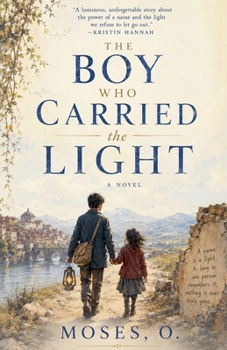
The Boy Who Carried the Light

In the riverside town of Avesha, in the small country of Marenne, eleven-year-old Teo keeps a secret book. Into it he writes the name of every person, every animal, and every small beloved thing the world is about to forget-because his grandmother taught him that a name is a light, and that as long as one person remembers it, nothing is ever truly gone.
Then the soldiers come.
The army they call the Column does not only take towns. It burns the records, the registries, the gravestones; it erases the names of the places it conquers so that, a generation later, no one will be able to prove those places ever lived. When the war reaches the river and Avesha begins to die, Teo is left with a brass keeping-lamp, a book full of names, and his six-year-old sister Mira's hand in his-and a whole country to cross to reach the rumor of safety in the west.
On a road crowded with the lost, hunted by men who burn memory the way other armies burn fields, a boy who has promised his grandmother that he will never let a single light go out must decide which ones he can bear to carry. He will lose more than he thought a person could survive losing. He will meet a deserter who is running from his own ledger of names, a woman who gathers abandoned children, and, at last, the friend he believes he betrayed. And he will arrive, finally, in the safe and well-lit cities of the watching world-only to discover that the hardest name to keep is the one he can never bring himself to write.
THE BOY WHO CARRIED THE LIGHT is a novel about memory and survival; about what we owe the people we lose; about the difference between forgetting in order to live and remembering in order to stay human. It is the story of one small boy's refusal, against an army and against grief itself, to let the world go dark.
Told in Teo's luminous, unforgettable voice, it is written for the reader who loved THE KITE RUNNER, ALL THE LIGHT WE CANNOT SEE, and A LONG WAY GONE-and for anyone who has ever been asked to carry more light than two hands can hold.
The complete novel runs thirty-five chapters. What follows is the full text. Part One carries Teo from the world of Avesha before the war, through the slow tightening of the noose, to the night the sky fell. Part Two, The Road, follows the boy west: the seventh day, on which he both finds and loses what he loves most; the woman who gathers the children no one else will keep; and the crossing, at the last bridge, into the safe country. Part Three, The Well-Lit Years, traces the keeper's life in a world that does not need his lamp-the anger, the love, the children, the book that opens, and the letter that calls him home. Part Four, The Ground, is the return: to Avesha, to Mira, to the reckoning with Karo, to the last blank page, and to the light that the road was always carrying toward.
Customer Reviews
ThriftBooks ® and the ThriftBooks ® logo are registered trademarks of Thrift Books Global, LLC
