


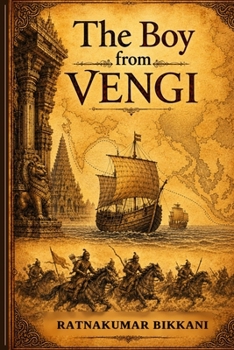
The Boy from Vengi
No Customer Reviews

The Boy from Vengi - Synopsis
In 1180, in Chola-era Andhra, an old physician delivers his grandson and pronounces a divided prophecy: some children are born to live, some to search. He names the boy Shivayya. Raised between his priest father and physician grandfather, a Kalinga raid forces the family to flee to Kanchipuram, where his great-uncle's medical practice becomes his real education.
Under his great-uncle and physician Ponnambalam, Shivayya masters Ayurvedic medicine. Under tantric teacher Paramananda, he takes a lifelong vow of celibacy and conserved vitality - his first self-chosen discipline. When Kanchipuram's ruler falls, he leaves for Angkor, where under Suryakumara and the dying king Jayavarman VII he learns a Buddhist medical tradition and senses how thin the line is between settlement and truce.
Escorting a cured Dali princess toward the Jin court, he spends a year absorbing a third tradition, and hears of a steppe chieftain, Tem jin, remaking Mongol politics. Delaying his journey, Shivayya is swept up when the Mongols invade in 1211. Captured, then trusted as a camp physician, he works through Zhongdu's ruins after its 1215 fall and begins a reckoning with the war's cost - suppressed when Genghis Khan summons him and he answers that a wound does not know whose war it belongs to. The Khan takes him into service.
Afterward, Shivayya learns a fifth tradition from the Tibetan monk Lobsang. When a Khwarezmian governor slaughters a Mongol caravan at Otrar, part of him welcomes the coming war as a reckoning. The campaign carries him through Otrar's siege, the crossing to Bukhara, Genghis's declaration that he is "the punishment of God," and Samarkand's surrender. He privately teaches Genghis his breath discipline; the Khan admits it buys him not peace but the ability to sleep.
At Nishapur in 1221, after Genghis's son-in-law is killed, his widow demands total vengeance, and it is granted. Shivayya's doubt breaks open; he extends care to the conquered, and a refusal to withhold treatment from condemned prisoners brings him before Genghis again. He admits neutrality is no longer enough; the Khan lets him stay changed.
Herat, spared once, rises against its garrison and is annihilated a second time. Shivayya, elsewhere, cannot return for years, and withdraws toward the conquered peoples' physicians, admitting he wants to go home.
He never does. Visiting Herat's ruins in 1226, he asks Genghis to release him to rebuild as a civilian physician there. Genghis grants it, giving him a ruined house and asking only that he treat the people well. He spends his last year building a garden, a practice, and a found family - including Duan Amei, reappeared after two decades, and a young student, Farrukh, taught a gentler version of his discipline.
In 1180, in Chola-era Andhra, an old physician delivers his grandson and pronounces a divided prophecy: some children are born to live, some to search. He names the boy Shivayya. Raised between his priest father and physician grandfather, a Kalinga raid forces the family to flee to Kanchipuram, where his great-uncle's medical practice becomes his real education.
Under his great-uncle and physician Ponnambalam, Shivayya masters Ayurvedic medicine. Under tantric teacher Paramananda, he takes a lifelong vow of celibacy and conserved vitality - his first self-chosen discipline. When Kanchipuram's ruler falls, he leaves for Angkor, where under Suryakumara and the dying king Jayavarman VII he learns a Buddhist medical tradition and senses how thin the line is between settlement and truce.
Escorting a cured Dali princess toward the Jin court, he spends a year absorbing a third tradition, and hears of a steppe chieftain, Tem jin, remaking Mongol politics. Delaying his journey, Shivayya is swept up when the Mongols invade in 1211. Captured, then trusted as a camp physician, he works through Zhongdu's ruins after its 1215 fall and begins a reckoning with the war's cost - suppressed when Genghis Khan summons him and he answers that a wound does not know whose war it belongs to. The Khan takes him into service.
Afterward, Shivayya learns a fifth tradition from the Tibetan monk Lobsang. When a Khwarezmian governor slaughters a Mongol caravan at Otrar, part of him welcomes the coming war as a reckoning. The campaign carries him through Otrar's siege, the crossing to Bukhara, Genghis's declaration that he is "the punishment of God," and Samarkand's surrender. He privately teaches Genghis his breath discipline; the Khan admits it buys him not peace but the ability to sleep.
At Nishapur in 1221, after Genghis's son-in-law is killed, his widow demands total vengeance, and it is granted. Shivayya's doubt breaks open; he extends care to the conquered, and a refusal to withhold treatment from condemned prisoners brings him before Genghis again. He admits neutrality is no longer enough; the Khan lets him stay changed.
Herat, spared once, rises against its garrison and is annihilated a second time. Shivayya, elsewhere, cannot return for years, and withdraws toward the conquered peoples' physicians, admitting he wants to go home.
He never does. Visiting Herat's ruins in 1226, he asks Genghis to release him to rebuild as a civilian physician there. Genghis grants it, giving him a ruined house and asking only that he treat the people well. He spends his last year building a garden, a practice, and a found family - including Duan Amei, reappeared after two decades, and a young student, Farrukh, taught a gentler version of his discipline.
Format:Paperback
Language:English
ISBN:B0HK4S7DXP
ISBN13:9798174989580
Release Date:September 2026
Publisher:Independently published
Length:474 Pages
Weight:1.39 lbs.
Dimensions:9.0" x 1.2" x 6.0"
Customer Reviews
0 rating
Copyright © 2026 Thriftbooks.com
Terms of Use | Privacy Policy | Do Not Sell/Share My Personal Information | Cookie Policy | Cookie Preferences | Accessibility Statement
ThriftBooks ® and the ThriftBooks ® logo are registered trademarks of Thrift Books Global, LLC
ThriftBooks ® and the ThriftBooks ® logo are registered trademarks of Thrift Books Global, LLC
