


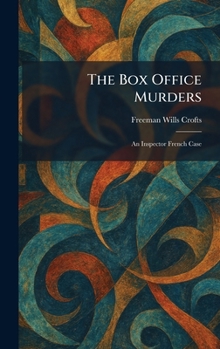
The Box Office Murders: An Inspector French Case

"The Box Office Murders" is a classic Golden Age detective novel featuring the methodical and persevering Inspector Joseph French of Scotland Yard. When a young woman working at a London cinema box office is found murdered, French is called in to solve what initially appears to be a straightforward case. However, the investigation soon spirals into a complex web of international crime, money laundering, and extortion.
Known for his signature attention to detail and logical deduction, Inspector French must navigate a maze of false identities and meticulously constructed alibis to uncover the truth. Written by Freeman Wills Crofts, a master of the police procedural, this work exemplifies the rigorous forensic investigation and procedural realism that became his trademark. As French travels from the streets of London to the industrial docks, readers are treated to a high-stakes pursuit of justice.
"The Box Office Murders" remains a quintessential example of early twentieth-century British crime fiction, highlighting the transition from the gentleman amateur to the professional police investigator. It is a compelling read for fans of intricate plots and authentic detective work.
This work has been selected by scholars as being culturally important, and is part of the knowledge base of civilization as we know it. This work was reproduced from the original artifact, and remains as true to the original work as possible. Therefore, you may see the original copyright references, library stamps (as most of these works have been housed in our most important libraries around the world), and other notations in the work.
This work is in the public domain in the United States of America, and possibly other nations. Within the United States, you may freely copy and distribute this work, as no entity (individual or corporate) has a copyright on the body of the work.
As a reproduction of a historical artifact, this work may contain missing or blurred pages, poor pictures, errant marks, etc. Scholars believe, and we concur, that this work is important enough to be preserved, reproduced, and made generally available to the public. We appreciate your support of the preservation process, and thank you for being an important part of keeping this knowledge alive and relevant.
Customer Reviews
ThriftBooks ® and the ThriftBooks ® logo are registered trademarks of Thrift Books Global, LLC
