


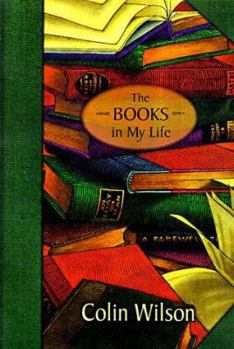
The Books in My Life


Wilson, who shares his home with over 20,000 books, pinpoints the books that have made a difference in his life and challenged him to learn. This description may be from another edition of this product.
Format:Paperback
Language:English
ISBN:1571741119
ISBN13:9781571741110
Release Date:January 1998
Publisher:Hampton Roads Publishing
Length:238 Pages
Weight:1.00 lbs.
Dimensions:9.0" x 0.8" x 6.0"
Customer Reviews
5 ratings
a true gem of a book, but not an impartial philosophy
Published by Thriftbooks.com User , 24 years ago
first of all, i love colin wilson's work and recommend that everyone buy this and read it whenever they have the chance. it is vivid, extremely well written, and (most likely)creates in the reader that incredible and inspiring enthusiasm for ideas that wilson has. actually, i would say that his work has serious philosophical value and should be referred to by not only casual readers of the field but serious students of all kinds, although he is widely considered a crank and a pseudo thinker. on the other hand, over the years i have come to certain realizations about wilson and his professed 'optimism' and cheery outlook on human life. wilson accuses pessimistic philosophers and writers (huysmans, camus) of having gloomy temperaments and intellectualizing their own personal misery into literary condemnations of human existence, but anyone with half a brain can tell that wilson does the exact same thing, only in reverse. it is as if he says to himself, "this pessimism and sterility in 20th century literature is a dead end and discourages creativity even if it is true. therefore i will make an illusory rationalization of why pessimism and realism are false and a completely bogus theory of why optimism is true. (***)nonetheless, wilson is a truly passionate thinker (albeit one who engages in error and is clearly tainted with the snobby disdain virus that so many intellectuals are) with a natural propensity to explore and illuminate obscure philosophy and literature. just be wary of his claims to impartiality and objectivity.
Great books need more thought
Published by Thriftbooks.com User , 24 years ago
CW wrote "The Books in My Life" when he was 66 or 67 years old. I got the feeling while reading it that he chose books and authors not necessarily because they were favorites but to illustrate his "new existentialism" philosophy. I've been reading Wilson for nearly a quarter of a century and I'm afraid he's reached the intellectual cul-de-sac that he so admonishes in others (particularly Sartre). I've always liked Wilson's aggressive style, the confidence in his ideas, his wide array of interests and his erudition. When I began reading CW I searched out the authors he wrote about. Sartre, Camus, Dostoevsky, Shaw, Huysmans, Hemingway, Mann, ad infinitum (I don't have the time to read as he does). Very few of them had CW's fundamentally optimistic approach to life. When the authors told their tales, filled with heroism, morbidity, intelligence and stupidity, and took them to honest conclusions, CW wagged his finger and said "tut, tut." Where is the positive payoff for all the preceding misery, he wondered. He's like the man who will put up with two hours of wretchedness in a film as long as there is an upbeat, life-affirming ending. CW bases his literary criticism on "peak experiences" (Maslow) and "absurd good news" (Chesterton), brief snippets of insight we all get from time to time where our senses amplify what is in front of us and we see things differently. CW maintains we see new meanings this way. But a rose is still a rose after all. As an analogy (and Wilson loves analogies), it's like a boy who digs in his yard and finds a gold coin. He thinks, if I dig up my whole yard think of all the gold coins I will find. What if I dig up my whole neighborhood? An adult would tell the boy, if you dig up your whole yard, all your apt to find are a few bottle caps and tin cans. Therein lies the central problem with CW's philosophy: He takes the exception as the rule. He says everyday consciousness is a liar but there is no lie about it. What is deceiving is the "peak experience" which is no more than a mirage, an oasis surely to vanish upon analysis. Great literature is not conceived toward optimism. It seeks to reflect reality, warts and all. Most people's lives are not full of giddy, holiday consciousness (especially in the 20th century where most of Wilson's examples come from), but we all have our moments. But the author who concentrates on these moments above all others is being deceitful and shallow and taking the easy way out. I take particular umbrage with CW's assault on Sartre. CW considers him a gloomy pessimist but Sartre actually believed in something (the Resistance, leftist ideals, man as a useless passion) and wrote a blueprint for a generation that succeeding generations can learn from. Wilson is an armchair quarterback who hurls criticism at every play but has never played the game. In all my readings of CW (and it's most of his work), I've never seen him indicate a belief in anything except his solipsism. History will always accor
Educational...
Published by Thriftbooks.com User , 25 years ago
...without being pedantic. In "The Books in My Life", Colin Wilson gives a highly personal, semi-autobiographical account of the books that have influenced him most throughout his life. As such, this is not a dry survey of "great books" (although some classics are mentioned), but rather an account of how the literature he encountered during his youth shaped the philosophy of the man who at the age of 24 would break into literary fame with "The Outsider", his first book. The first chapter, "The Truth About Wilson", doesn't refer to Colin Wilson, but rather to a serialized adventure story he read in a boys' magazine when he was about ten. The next chapter deals with Tom Sawyer, which he was assigned to read in school. One of the great things about this book is that Wilson is not afraid to express his own opinions on the "classics" of literature. For example, he says that while he found Tom Sawyer riveting, Huckleberry Finn--Mark Twain's supposed "masterpiece"--was a great disappointment to him, as a boy and also when he returned to it as an adult. He discusses the influence on his life of Dostoevsky, William and Henry James, Plato, Joyce, and Sartre, but also Sherlock Holmes and Shaw. He also discusses relatively unknown authors such as David Lindsay, who wrote "A Voyage to Arcturus", and the Russians Leonid Andreyev and Mikhail Artsybashev.The common thread running through "The Books in My Life" is how each of these books inspired his belief that humans can be greater than they usually are, or lended support to his philosophy of the Outsider, or gave an example of what happens when authors fail to grasp the significance of what they themselves are writing and then sink into despair.This is an interesting book that will get you to think about the books that have shaped your own life.
Autobiography Through Bibliography
Published by Thriftbooks.com User , 26 years ago
This is an introduction to the books that most shaped Colin Wilson's ideas. And it is somewhat surprising - not every book on this list is an "outsider" book. One of the interesting things about this book is that it is autobiography through bibliography. Wilson chronologically traces his personal development and the development of his thought through the books that most influenced him - from his earliest experience with reading to the present. And some of the choices-like Edgar Rice Burroughs and Arthur Conan Doyle--are surprising. Also interesting is Wilson's defense of his various tastes. It's a rare treat when someone shares their person aesthetic preferences, and Wilson, as a lifetime reader, does this well. For one example, he describes how his former love for G.B. Shaw's plays faded as he got older. For fans of Wilson, this is a welcome insight to how his ideas developed.
make me want to read the books he read
Published by Thriftbooks.com User , 26 years ago
i found this book in a used book store, simply because of the title. that's the best $5.00 i have ever paid.there are 20 some episodes, covering the books Wilson read. from easy detective story to difficult phylosophy works. it shows how can reading build a man, and it makes me want to read all the books he read, to see whether i agree with his comments or not.I feel Wilson's positive philosophy from the first page to the end, though his comments (especially the one on Joyce) is debatable, but his optimism makes life shining. He reads every joyful drop of life from books, even from the books by the gloomy existmentists. He makes reading and meditation no more a depressing process.i wish i could find this book 10 years earlier, and start to read all the books he covered in this book.
Copyright © 2026 Thriftbooks.com
Terms of Use | Privacy Policy | Do Not Sell/Share My Personal Information | Cookie Policy | Cookie Preferences | Accessibility Statement
ThriftBooks ® and the ThriftBooks ® logo are registered trademarks of Thrift Books Global, LLC
ThriftBooks ® and the ThriftBooks ® logo are registered trademarks of Thrift Books Global, LLC
