


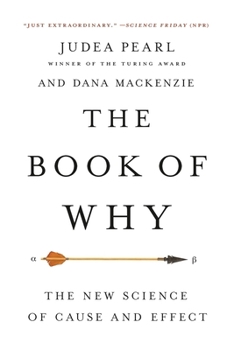
The Book of Why: The New Science of Cause and Effect
No Customer Reviews


Select Format
Select Condition 
Book Overview
The "extraordinary" (Science Friday), "illuminating" (New York Times) argument for how understanding causality has revolutionized science and will revolutionize artificial intelligence "Correlation is not causation." This mantra, chanted by scientists for more than a century, once led to a virtual prohibition on causal talk. Today, with causal analysis taking center stage in AI and other applications, the old taboos are a thing of the past. The causal revolution, instigated by Judea Pearl and others, established causality on a firm scientific basis. Pearl showed how intuitive models can interface with data to help answer causal questions, such as whether a drug will cure an illness or, counterfactually, whether an illness would have persisted absent the drug. These models provide a blueprint for causal AI to learn and take responsibility for its mistakes. Updated with a new introduction and summary of recent advances, The Book of Why outlines the basics of cause and effect for lay readers and scientists alike, providing tools to explore the observable world and worlds that might have been.
Format:Paperback
Language:English
ISBN:1541608984
ISBN13:9781541608986
Release Date:October 2026
Publisher:Basic Books
Length:448 Pages
Dimensions:1.0" x 5.5" x 8.3"
Customer Reviews
0 rating
Copyright © 2026 Thriftbooks.com Terms of Use
| Privacy Policy | Do Not
Sell/Share My Personal Information | Cookie Policy | Cookie Preferences | Accessibility Statement
ThriftBooks® and the ThriftBooks® logo are registered trademarks of Thrift Books Global, LLC
ThriftBooks® and the ThriftBooks® logo are registered trademarks of Thrift Books Global, LLC
