


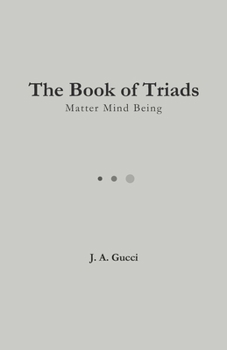
The Book of Triads

The Book of Triads is a collection of poems structured around a simple but generative principle: meaning emerges through tension between three forces rather than resolution between two.
Each poem is organized as a triad-often moving through material, perceptual, and existential registers-allowing image, thought, and being to interact without collapsing into explanation. Rather than narrating experience, the book presents compressed fields in which attention, sensation, and abstraction exert pressure on one another.
The work does not seek interpretation or closure. Instead, it treats poetry as a system: a set of constraints that reveal how language behaves under balance, imbalance, and recurrence. Across its sections, The Book of Triads explores paradox not as contradiction, but as a stable condition for perception and thought.
Minimal in surface and rigorous in structure, the poems invite slow reading and repeated engagement. The book functions both as a standalone poetic work and as a foundational text for the larger system that informs the author's subsequent collections.
Customer Reviews
ThriftBooks ® and the ThriftBooks ® logo are registered trademarks of Thrift Books Global, LLC
