


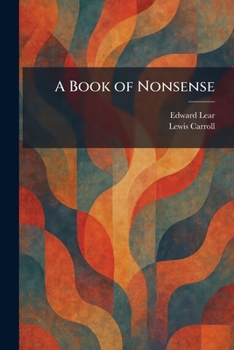



Book Overview
"A Book of Nonsense" stands as a cornerstone of Victorian literature, celebrated for its whimsical spirit and innovative use of language. This collection showcases the delightful absurdity of the limerick form, a genre perfected and popularized through the wit of its creators. Through a series of playful verses, the work explores a world where the ordinary becomes extraordinary and the logical is gleefully discarded in favor of pure, imaginative fun.
Focusing on the surreal adventures of eccentric characters, the book employs masterful wordplay and a rhythmic cadence that has charmed readers for generations. This volume captures the essence of nonsensical poetry, bridging the gap between children's literature and sophisticated literary satire. Associated with the pioneering minds of Edward Lear and Lewis Carroll, the work remains a vital example of the literary nonsense movement, emphasizing humor that is both lighthearted and profoundly clever.
Whether exploring the strange habits of an "Old Man with a Beard" or the peculiar logic of the Victorian era, "A Book of Nonsense" provides a timeless escape into the joy of the ridiculous. It remains an essential read for those who appreciate the historical development of English humor and the enduring power of the imagination.
This work has been selected by scholars as being culturally important, and is part of the knowledge base of civilization as we know it. This work was reproduced from the original artifact, and remains as true to the original work as possible. Therefore, you may see the original copyright references, library stamps (as most of these works have been housed in our most important libraries around the world), and other notations in the work.
This work is in the public domain in the United States of America, and possibly other nations. Within the United States, you may freely copy and distribute this work, as no entity (individual or corporate) has a copyright on the body of the work.
As a reproduction of a historical artifact, this work may contain missing or blurred pages, poor pictures, errant marks, etc. Scholars believe, and we concur, that this work is important enough to be preserved, reproduced, and made generally available to the public. We appreciate your support of the preservation process, and thank you for being an important part of keeping this knowledge alive and relevant.
Customer Reviews
Deep Genius, Required reading for any age
Love this book/CD-rom
So You Don't Get It
Every child needs some nonsense
Delightful cd renderings as well
A Classic for all ages!
ThriftBooks® and the ThriftBooks® logo are registered trademarks of Thrift Books Global, LLC
