


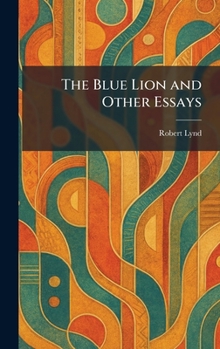
The Blue Lion and Other Essays

"The Blue Lion and Other Essays" is an evocative collection of personal reflections by the celebrated writer and journalist Robert Lynd. Known for his keen eye for detail and a gentle, humorous touch, Lynd explores a vast array of subjects ranging from the charms of the natural world and the behavior of birds to the peculiarities of human habits and social interactions. In these essays, he elevates the mundane-whether it is the sight of a lion on a pub sign or the simple pleasure of a walk-into profound observations on the human condition.
Lynd's writing is characterized by its warmth, wit, and conversational style, making this volume a quintessential example of the early 20th-century familiar essay. His ability to find wonder in the everyday allows readers to reconnect with the world around them through a lens of curiosity and intelligence. This collection captures a specific era of literary craftsmanship, offering readers a delightful escape into the thoughtful and often whimsical mind of one of the period's most beloved essayists. "The Blue Lion and Other Essays" remains a testament to the enduring appeal of the short-form narrative and the art of the literary sketch.
This work has been selected by scholars as being culturally important, and is part of the knowledge base of civilization as we know it. This work was reproduced from the original artifact, and remains as true to the original work as possible. Therefore, you may see the original copyright references, library stamps (as most of these works have been housed in our most important libraries around the world), and other notations in the work.
This work is in the public domain in the United States of America, and possibly other nations. Within the United States, you may freely copy and distribute this work, as no entity (individual or corporate) has a copyright on the body of the work.
As a reproduction of a historical artifact, this work may contain missing or blurred pages, poor pictures, errant marks, etc. Scholars believe, and we concur, that this work is important enough to be preserved, reproduced, and made generally available to the public. We appreciate your support of the preservation process, and thank you for being an important part of keeping this knowledge alive and relevant.
Customer Reviews
ThriftBooks ® and the ThriftBooks ® logo are registered trademarks of Thrift Books Global, LLC
