


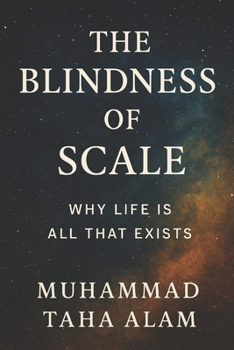
The Blindness of Scale: Why Life is All That Exists

What if life is not the exception but the rule?
For centuries, science has struggled to define life. We know a tree is alive and a stone is not, yet every attempt at a clear definition collapses under scrutiny. Viruses blur the line. Machines begin to surprise us with creativity. Earth regulates its climate and oceans as though it were a body. The universe itself generates novelty across billions of years.
In The Blindness of Scale: Why Life Is All That Exists, Muhammad Taha Alam argues that life is not a one-time accident but a recurring principle. At every scale of complexity, from molecules to cells, from organisms to Gaia, from planets to the cosmos, the spark of life returns. What blinds us to this truth is scale itself. Molecules cannot see the life of a cell. Cells cannot see the life of an organism. We cannot easily see the life of Earth or the universe.
Drawing on science, philosophy, and myth, this book unfolds a radical vision: we live not in a dead universe punctuated by accidents of life, but in a living universe where life is the underlying reality.
The journey begins with blindness, moves through the surprising vitality of machines, explores Gaia as a planetary body, expands to the living cosmos, and ends with an ethic of scale that calls us to humility and responsibility.
This is not a book about philosophy alone. It is a book about belonging. To see life at all scales is to rediscover our place in a living whole, and to learn to live as if belonging truly matters.
Customer Reviews
ThriftBooks® and the ThriftBooks® logo are registered trademarks of Thrift Books Global, LLC
