


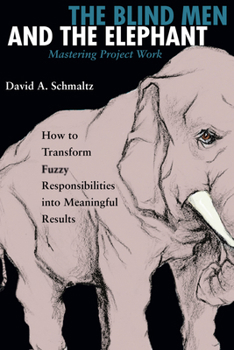
The Blind Men and the Elephant: Mastering Project Work

If you work, you probably manage projects every day-even if "project manager" isn't in your official title-and you know how frustrating the experience can be. Using the familiar story of six blind men... This description may be from another edition of this product.
Format:Paperback
Language:English
ISBN:1576752534
ISBN13:9781576752531
Release Date:January 1
Publisher:Berrett-Koehler Publishers, Incorporated
Length:160 Pages
Weight:0.54 lbs.
Dimensions:0.5" x 6.0" x 8.9"
Related Subjects
Business Business & Investing Economics Management Management & Leadership Project ManagementCustomer Reviews
5 ratings
Getting Real about Project Management
Published by Thriftbooks.com User , 19 years ago
If you've ever owned an animal, you know what it's like to have expectations that don't match "reality"--there's what "the book" says about how your animal should behave, and then there's what it actually does. So it seems fitting that Schmaltz should use an animal--an elephant, to be precise--as a metaphor for a project, and then weave a lovely, poetic whole about the "behavior" of projects that contains more actual truths than other books with lots of charts, graphs and examples designed to make you an expert, of sorts, on the subject. If you've never actually managed a project, this book might seem confusing to you. If you only manage projects that deal with "stuff" (construction projects, for example), the metaphors might not seem as apt. But if you manage projects that engineer large systems out of computer equipment and "thin air," then you will feel right at home with this meander through the shifting landscape of projects of this type. In fact, you will be amazed that someone else has observed the same things you have--that these types of projects do not seem to be reliably predictable, no matter how much effort we put into making them "behave!" Schmaltz does what only a master can do: Identifies the patterns hidden within the unpredictability, and presents them in a way which evokes a sense of familiarity in the reader. I had many déjà vu, been-there-done-that, and wow-that-happened-to-someone-else-too experiences reading this book. In so many ways, one of the great values of this book to me was simply in confirming my experiences. It's not me, I can finally say, and it's not even the projects, that lead to deviations from expectation. It's actually the nature of our expectations themselves regarding the inherent manageability of projects that is at issue. I need to get past the idea that there is a definitive "book" or "method" to go by, and get on with making projects actually work! Schmaltz' offering went a long way toward preparing me to do that. The chapter on motivation ("Can a project leader fan the embers of commitment into a dedicated, high-performance flame?") alone made the book worth reading for me. I also very much appreciated his treatment of "generosity" in the interpretation of events ("The most generous possible interpretation transforms difference from definition into information.") Schmaltz' concepts have real-life applications; I will never look at projects in the same way again after reading this book. I recommend a companion purchase: "Taming Wicked Projects," an audiobook by Amy Schwab, Schmaltz' business partner and wife. Schwab elaborates in this CD on many of the topics and metaphors presented in The Blind Men and the Elephant (so I suggest reading the book first), and extends and adds to them with her own considerable experience in the field. I do hope you get as much out of these works as I did.
The critical human dimension of project work
Published by Thriftbooks.com User , 21 years ago
This quick, well-written, and thought provoking book addresses the human dimension of project work too often lost behind GANTT charts, change controls, and scheduling tools. Schmaltz serves up uncomfortable realities about the world of project work. By confronting us with our Master/Slave frame of reference, he helps us understand how we unwittingly enslave ourselves to our Masters and how we can free ourselves with no one else's permission. Schmaltz reveals what great project managers have known forever about making their projects really work well -- clarity of purpose and strength of relationship are essential, and the responsibility and power to achieve those essential elements lie in each individual's hands. As he says in the preface, if you want a book to tell you what to do and how to make your projects turn out perfectly, take a pass. If you want a book with a bulleted list of how-to's, keep looking. If you are interested in shifting your perspective on your projects and learning how to approach them in a way that leaves you the master of your own experience, this book is for you.
Find the Juicy Part of Every Project You Do
Published by Thriftbooks.com User , 22 years ago
Here's a new way to look at complex development work: Your project is an invisible elephant. It's standing in a room, waiting to be revealed by a group of groping teammates. Like the six blind men from Indostan in John Godfrey Saxe's famous poem, "The Blind Men and the Elephant," we encounter pieces of projects, rarely the whole elephant. We grasp whatever we can -- an ear, a tail, a trunk, a leg, a tusk, a broad, flat side. Based on what we grasp -- our piece of the project -- we extrapolate an understanding of the whole: a fan, a rope, a snake, a tree, a spear, a wall. Author David A. Schmaltz, in his book named after the poem, develops these analogies in terms of project experience. We encounter a fan that brings us fresh air, a rope that binds us together, a snake that abuses our trust, a tree that evolves in structure above and beneath the surface, a spear that puts us on the defensive, a wall that challenges our personal progress. A chapter is devoted to each analogy.This isn't a storybook, though. These simple metaphors are touchstones for Schmaltz's broad exploration of what makes projects meaningful. Schmaltz sheds light on the dark matter of project management -- the stuff that blocks us from succeeding on projects as individuals and as teams. He even leads us through the panicked self-talk that runs through a manager's head at the start of a project. With rich writing that's rare in management books, Schmaltz gives us a 360 view of project management itself -- project management is this book's invisible elephant. The elephant emerges.You won't find any worksheets, diagrams, flow charts, procedures, instructions, or textbook problems in this book. Schmaltz gives us something more valuable and memorable: fresh ways to think about how we approach and manage projects. For example, managers should encourage each person to find a personal project within each project, something personally "juicy" to sustain interest and make the effort valuable. Going beyond the stated objectives of a project, each of us needs to ask ourselves, "What do you want?" -- and to keep asking that until our personal goals emerge. These goals don't compete with the team's purpose -- they bind us to the project's success. This is the process of what Schmaltz calls "finding your wall." Just as managers should encourage this kind of buy-in rather than trying to externally motivate a team, managers should not impose a prefabricated structure onto a team. Schmaltz argues that when people find a personally juicy goal within a project, they will strive to structure their efforts in an efficient, organic manner -- without taking that twenty-volume project methodology off the shelf. On a person-to-person level, Schmaltz asserts that despite the risk of getting cheated by snake-like deceivers, project members are most wise to interpret people's actions generously, assuming the best and freely offering trust and help. Using the results of a computer program
"People and Collaboration" Over "Process and Controls"
Published by Thriftbooks.com User , 23 years ago
This is a book you have to read, by this I mean it is both an important text that should be read and a book you can not dip-into or skim. You have to read it carefully to absorb the concepts that build upon each other to provide great insights into how projects actually work. The descriptions are rich and complex but because the book is small (under 130 pages) it never feels overwhelming and the topics are well covered but not repeated or over stated. Recognition is growing around the fact that successful projects are more about people, collaboration and communications than creating plans and following processes. The success and growth of agile methodologies in software development is testimony to this shift in priorities and through this book, David Schmaltz explains why this is the case and offers suggestions for improving project outcomes. The clever use of the "Blind Men" poem ties the main concepts of the book together in an engaging manner and provides an uncomfortably apt analogy for many of the classic project management struggles. This book provides valuable guidance for project managers and highlights the key areas to focus on to achieve better project outcomes.
Project management as a human activity? Wow!
Published by Thriftbooks.com User , 23 years ago
I've got quite a shelf of books on project management, some excellent, some not so good, but nearly all centering on the mechanics of planning, organizing, and controlling a project effort. What's been lacking is a good view of projects as a human activity--which is kind of strange, since every project I've ever seen has been carried out by human beings.David Schmaltz's book, "The Blind Men and the Elephant," is a welcome addition to the project management literature. It won't teach you how to draw a PERT chart, or use Microsoft Project, or construct a formal work breakdown and budget. What it will do is give you some invaluable tools for thinking about projects and the people who do them--including yourself.Schmaltz uses John Godfrey Saxe's classic poem about the blind men who perceive an elephant (depending on which part they touch) as a wall, a spear, a snake, a tree, a fan and a rope to illustrate lessons about human beings in project situations--lessons ranging from the only form of real motivation (what do you really want from your participation in this project?) to the nurturing of communities that truly cooperate and support each other in carrying out a project. The style is personal, idiosyncratic and quirky, in the best sense of the words--the lessons are presented and illustrated with personal stories that are a delight to read even if you're not trying to manage a project at the moment."The Blind Men and the Elephant" is not a replacement for a good textbook on organizing and managing the mechanics of a project; it's something far harder to find--an essential addition to the shelf of any project manager who might someday have to deal with human beings.
Copyright © 2026 Thriftbooks.com
Terms of Use | Privacy Policy | Do Not Sell/Share My Personal Information | Cookie Notice | Cookie Preferences | Accessibility Statement
ThriftBooks ® and the ThriftBooks ® logo are registered trademarks of Thrift Books Global, LLC
ThriftBooks ® and the ThriftBooks ® logo are registered trademarks of Thrift Books Global, LLC
