


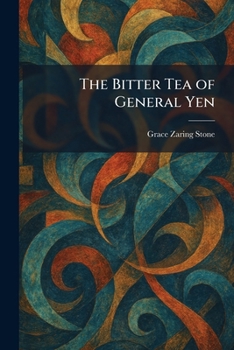
The Bitter Tea of General Yen

Select Format
Select Condition 
Book Overview
"The Bitter Tea of General Yen" is a compelling exploration of cultural confrontation set against the turbulent backdrop of the Chinese Civil War. When Megan Davis, an idealistic young American, travels to Shanghai to marry a missionary, she finds herself caught in the chaos of a violent revolution. Her path unexpectedly intersects with the enigmatic General Yen, a powerful and sophisticated warlord who rescues-and subsequently detains-her at his palace.
As Megan is exposed to the complexities of Chinese politics and the General's philosophical worldview, her rigid Western preconceptions and moral certainties are deeply challenged. Grace Zaring Stone masterfully crafts a narrative that delves into the tension between Eastern and Western values, the brutality of war, and the blurred lines between civilization and barbarism. This classic work of 20th-century literature offers a nuanced portrait of a nation in transition and remains a poignant study of human nature and the inevitable clashes that arise from mutual misunderstanding. Through its atmospheric prose, the novel captures the exoticism and danger of 1920s China while maintaining a sharp focus on the psychological evolution of its protagonists.
This work has been selected by scholars as being culturally important, and is part of the knowledge base of civilization as we know it. This work was reproduced from the original artifact, and remains as true to the original work as possible. Therefore, you may see the original copyright references, library stamps (as most of these works have been housed in our most important libraries around the world), and other notations in the work.
This work is in the public domain in the United States of America, and possibly other nations. Within the United States, you may freely copy and distribute this work, as no entity (individual or corporate) has a copyright on the body of the work.
As a reproduction of a historical artifact, this work may contain missing or blurred pages, poor pictures, errant marks, etc. Scholars believe, and we concur, that this work is important enough to be preserved, reproduced, and made generally available to the public. We appreciate your support of the preservation process, and thank you for being an important part of keeping this knowledge alive and relevant.
Customer Reviews
ThriftBooks® and the ThriftBooks® logo are registered trademarks of Thrift Books Global, LLC
