


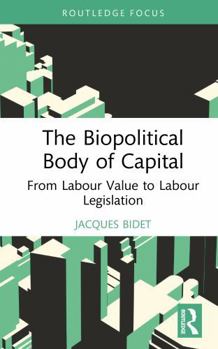
The Biopolitical Body of Capital: From Labour Value to Labour Legislation

Originally published in French, this English edition translated by Jacques Bidet offers a rigorous and interdisciplinary reading of Capital, challenging dominant mainstream interpretations that overlook Marx's critique of capitalist society. Centering on the chapter "The Working Day," the book reveals Marx's analysis of labor exploitation as a biopolitical struggle between capital and living labor. Drawing on Foucault's concept of biopolitics, it reframes wage labor as a conflict over bodily autonomy, social reproduction, and the limits of capitalist control.
Through a meticulous reconstruction of Marx's method--moving from abstract to concrete--eminent Marx scholar Jacques Bidet identifies three distinct levels of labor analysis (general, commodity-based, and wage labor), bringing clarity often lost in mainstream commentaries. He critiques influential interpretations by Harvey, Negri, Postone, and others, while acknowledging Marx's limits in theorizing race, gender, and nation. To address these gaps, Bidet proposes a "Marxist metastructural theory of modernity" that extends Marx's emancipatory vision.
Accessible yet scholarly, The Biopolitical Body of Marx's Capital is ideal for students and researchers in politics, philosophy, economics, sociology, and history. It speaks to readers seeking a politically engaged, analytically precise understanding of Marx's work--one that resonates with today's global crises and the urgent need for transformative change.
Customer Reviews
ThriftBooks ® and the ThriftBooks ® logo are registered trademarks of Thrift Books Global, LLC
