


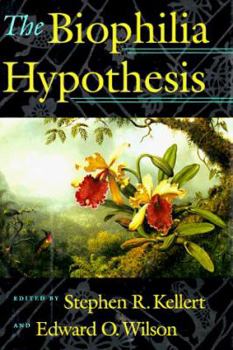
The Biophilia Hypothesis


Select Format
Select Condition 
Book Overview
"Biophilia" is the term coined by Edward O. Wilson to describe what he believes is humanity's innate affinity for the natural world. In his landmark book Biophilia, he examined how our tendency to... This description may be from another edition of this product.
Format:Hardcover
Language:English
ISBN:1559631481
ISBN13:9781559631488
Release Date:October 1993
Publisher:Shearwater
Length:496 Pages
Weight:1.85 lbs.
Dimensions:9.3" x 1.3" x 6.3"
Customer Reviews
3 ratings
an able collection that needs updating
Published by Thriftbooks.com User , 18 years ago
This book contains writings and research from several fields, their experts trying to confirm the hypothesis that human beings are naturally drawn to various manifestations of the natural world ("biophilia"). This hypothesis is important not because it can start a new religion or redeem the world, but because it balances more pessimistic views of human nature with the idea that we have a natural psychological connection to our fellow creatures. This in turn implies that we harm our own psyches to the extent we push other beings out of existence. Don't expect any end-stage science from this book. The editors make it clear up front that these are tentative, exploratory, and sometimes speculative investigations. The amount of biophilia research funding remains quite small compared to environmental research on how to market things or brainwash customers. The studies herein go up to the 1990s, so it's time for another collection. A chapter that puzzled me was written by Dorion Sagan and Lynn Margulis to argue that appeals to save the planet are grandiose. Granted; Joanna Macy has been making the point for decades that we are PART of the planet, not sitting high above it. At best we can participate in its self-healing from what humans have done to it. But the authors go beyond this to normalize what we have done to it, even suggesting that we could be making way for the next evolutionary experiment of Gaia. I hate to use the hard word "misanthropic," but dismissing global warming and mass extinctions with the suggestion that "the decline in species diversity may be balanced by an increase in technological diversity" is astounding. It is quite a contrast to the growing numbers of people who feel the pain of those disappearances and declines with agonizing urgency and sorrow. I'm concerned that it also supports the very passivity and hopelessness that deprive the public sphere of so much pro-environmental energy directed toward appreciating and encouraging Earth's self-healing complexity: a very different idealism from the heroic posture of the world-shaper.
Wonderful reading
Published by Thriftbooks.com User , 24 years ago
This was recommended by a scientist-science teacher-friend and I was simply blown away by the implications. If this theory is correct, then it explains the human descent into madness brought on by increased development without thought.
Difficult but important
Published by Thriftbooks.com User , 26 years ago
Human beings are deeply psychologically attached to nature and the sooner we realize that, the better off we'll be. Why are houseplants so popular? Why do so many children's books feature animals as main characters? Why do more Americans visit zoos than sporting events? Why are so many of us worried about rainforests we'll never see firsthand? Unlike the previous two reviewers, I hold that our ties with nature are deep and ancient. We can bury them under concrete but WE CAN'T CUT THEM. As a last word: most of the really happy people I know have a deep relationship with nature or something from nature, such as a pet.
Copyright © 2026 Thriftbooks.com Terms of Use
| Privacy Policy | Do Not
Sell/Share My Personal Information | Cookie Policy | Cookie Preferences | Accessibility Statement
ThriftBooks® and the ThriftBooks® logo are registered trademarks of Thrift Books Global, LLC
ThriftBooks® and the ThriftBooks® logo are registered trademarks of Thrift Books Global, LLC
