


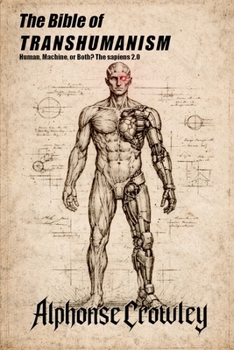
The Bible of TRANSHUMANISM: Human, Machine, or Both? The sapiens 2.0

The Transhumanist Bible is a work of non-fiction and a philosophical manifesto that confronts, without compromise, one of the central questions of our time: is the human being, as it exists today, sufficient?
This book is a radical European manifesto on transhumanism, rooted more in Nietzsche and bioethics than in the imagery of Silicon Valley or the rhetoric of futurism. It presents transhumanism not as science fiction, nor as a redemptive ideology, but as a material, scientific, and political process through which humanity attempts to overcome the limits imposed by its own biology. Aging, disease, cognitive decline, and evolutionary slowness are not treated as inevitabilities, but as technical problems that can be addressed.
The book explores:
the historical and conceptual origins of transhumanismthe real-world applications of biotechnology, neurotechnology, and artificial intelligencethe boundary between human and machinethe ethics of enhancement and individual responsibilitythe concept of Sapiens 2.0 as an intermediate evolutionary phasethe Kardashev scale as a civilizational perspective, not a utopian promiseThe text rejects every form of technological spiritualism, esotericism, and futurist mythology. There are no digital souls here, no mystical ascensions, no guaranteed redemptions. There is only matter, the body, the mind, and the human will to intervene in them consciously.
The Transhumanist Bible does not seek to persuade everyone.
It is written for those who reject biological resignation and accept that, from this point forward, evolution will no longer be a blind process.
The human being is not an endpoint.
It is a transitional phase.
Related Subjects
PhilosophyCustomer Reviews
ThriftBooks ® and the ThriftBooks ® logo are registered trademarks of Thrift Books Global, LLC
