


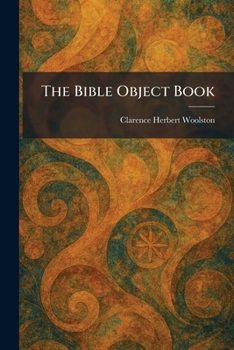
The Bible Object Book

Select Format
Select Condition 
Book Overview
"The Bible Object Book" is a practical guide to visual and tactile religious education, designed to help teachers and pastors convey spiritual truths through the use of everyday items. Written by Rev. Clarence Herbert Woolston, a pioneer in the field of object lesson teaching, this work provides a wealth of practical examples and methods for making biblical stories and theological concepts accessible and engaging for children and young audiences.
The text functions as a comprehensive manual for Sunday School ministry, offering creative strategies to bridge the gap between abstract scripture and the tangible world. Each lesson is meticulously structured to transform simple household objects into powerful symbols that illustrate moral lessons and scriptural narratives. By focusing on the art of visual storytelling, Woolston demonstrates how to capture interest and foster a deeper understanding of faith through imaginative demonstration. "The Bible Object Book" stands as a significant contribution to the history of Christian pedagogy, emphasizing the enduring value of creative illustration in religious instruction.
This work has been selected by scholars as being culturally important, and is part of the knowledge base of civilization as we know it. This work was reproduced from the original artifact, and remains as true to the original work as possible. Therefore, you may see the original copyright references, library stamps (as most of these works have been housed in our most important libraries around the world), and other notations in the work.
This work is in the public domain in the United States of America, and possibly other nations. Within the United States, you may freely copy and distribute this work, as no entity (individual or corporate) has a copyright on the body of the work.
As a reproduction of a historical artifact, this work may contain missing or blurred pages, poor pictures, errant marks, etc. Scholars believe, and we concur, that this work is important enough to be preserved, reproduced, and made generally available to the public. We appreciate your support of the preservation process, and thank you for being an important part of keeping this knowledge alive and relevant.
Customer Reviews
ThriftBooks ® and the ThriftBooks ® logo are registered trademarks of Thrift Books Global, LLC
