


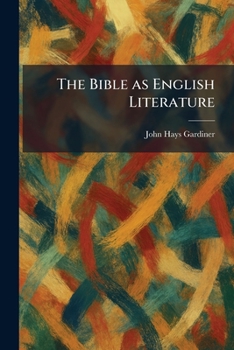
The Bible as English Literature

Select Format
Select Condition 
Book Overview
"The Bible as English Literature" provides a comprehensive analysis of the scriptures through the lens of literary art and historical influence. John Hays Gardiner examines the Bible's profound impact on the English language, focusing on the narrative power, poetic depth, and stylistic mastery found throughout the text. By approaching the Bible as a collection of literary works rather than strictly through a theological prism, this study highlights the aesthetic qualities that have shaped the Western literary canon.
The work explores the diverse genres contained within the Bible, from the vivid storytelling of the Old Testament to the lyrical intensity of the Psalms and the rhetorical strength of the Epistles. A significant portion of the analysis is dedicated to the King James Version, illustrating how its particular rhythms and phrasing became foundational to English prose and poetry. This book is an invaluable resource for those interested in the intersection of religion and literature, offering a scholarly yet accessible appreciation of the Bible's enduring legacy as a masterpiece of written expression. It underscores the vital role the scriptures play in the cultural and linguistic heritage of the English-speaking world.
This work has been selected by scholars as being culturally important, and is part of the knowledge base of civilization as we know it. This work was reproduced from the original artifact, and remains as true to the original work as possible. Therefore, you may see the original copyright references, library stamps (as most of these works have been housed in our most important libraries around the world), and other notations in the work.
This work is in the public domain in the United States of America, and possibly other nations. Within the United States, you may freely copy and distribute this work, as no entity (individual or corporate) has a copyright on the body of the work.
As a reproduction of a historical artifact, this work may contain missing or blurred pages, poor pictures, errant marks, etc. Scholars believe, and we concur, that this work is important enough to be preserved, reproduced, and made generally available to the public. We appreciate your support of the preservation process, and thank you for being an important part of keeping this knowledge alive and relevant.
Customer Reviews
ThriftBooks® and the ThriftBooks® logo are registered trademarks of Thrift Books Global, LLC
