


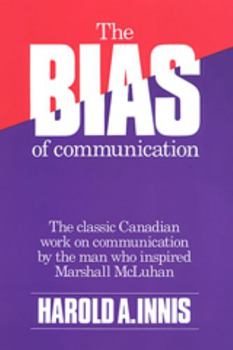
The Bias of Communication


Select Format
Select Condition 
Book Overview
One of the most influential books ever published in Canada, Harold A. Innis's The Bias of Communication has played a major part in reshaping our understanding of history, communication, and media theory. First published in 1951, this masterful collection of essays explores the relationship between a society's communication media and that community's ability to maintain control over its development. Innis considers political and economic forces in the context of social change and the role of communication in the creation of both ancient and modern empires. In an essay for this new edition, Innis biographer Alexander John Watson examines the reasons why Innis, at the height of his success as an economic historian, embarked on new research areas of communications and empire, as well as the ways in which Marshall McLuhan's interpretations of Innis changed and de-politicized Innis's work. As important today as it was when first published, The Bias of Communication is essential reading for historians and scholars of communication and media studies.
Format:Paperback
Language:English
ISBN:0802068391
ISBN13:9780802068392
Release Date:April 1999
Publisher:University of Toronto Press, Scholarly Publishing Division
Length:226 Pages
Weight:0.84 lbs.
Dimensions:9.0" x 0.6" x 6.0"
Customer Reviews
2 ratings
Innis is a powerful experience
Published by Thriftbooks.com User , 21 years ago
I find everything I read by Harold Innis deeply thought provoking. Even when he quotes what I feel are wrong headed observations by Marcel Granet or Winston Churchill on character based langauges where I feel his conjectures reflect the fact he had never experienced learning such a language or thinking in one [instead of encouraging mental inflexibility, I would say, the contrary is true - 'lateral thinking' represented a concept I would never had had to introduce for any of my Chinese students], he feels so honest and so undogmatic, he is stimulating rather than irritating. [The passage occurs in 'A Plea For Time', one of the interesting essays in this book.]He does not dogmatise but stimulates. He does not seek to preach but to help us participate in an ongoing process. In a way, he makes me feel, reading him, as I think a young Greek might have felt who had had the chance to spend time listening to Socrates.I am very enthusiastic about this book and treasure my copy. I have become deeply interested in everything by Innis I can find.
keys to understanding the phases of human/media development
Published by Thriftbooks.com User , 26 years ago
This book and its ideas have stayed with me over 15 years since university : Innis (who influenced Mcluhan) discusses the effect of changes in media on the history of civilization : ex. the invention of papyrus. sometimes obscure, but always a paradigm-shifter
Copyright © 2026 Thriftbooks.com Terms of Use
| Privacy Policy | Do Not
Sell/Share My Personal Information | Cookie Policy | Cookie Preferences | Accessibility Statement
ThriftBooks® and the ThriftBooks® logo are registered trademarks of Thrift Books Global, LLC
ThriftBooks® and the ThriftBooks® logo are registered trademarks of Thrift Books Global, LLC
