


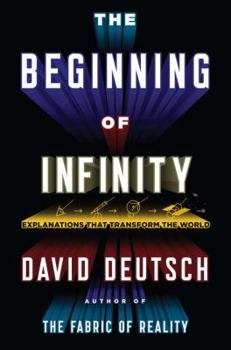
The Beginning of Infinity: Explanations That Transform the World

Select Format
Select Condition 
Book Overview
Selected by "The New York Times Book Review" as a Notable Book of the Year A bold and all-embracing exploration of the nature and progress of knowledge from one of today's great thinkers. Throughout history, mankind has struggled to understand life's mysteries, from the mundane to the seemingly miraculous. In this important new book, David Deutsch, an award-winning pioneer in the field of quantum computation, argues that "explanations" have a fundamental place in the universe. They have unlimited scope and power to cause change, and the quest to improve them is the basic regulating principle not only of science but of all successful human endeavor. This stream of ever improving explanations has infinite reach, according to Deutsch: we are subject only to the laws of physics, and they impose no upper boundary to what we can eventually understand, control, and achieve. In his previous book, "The Fabric of Reality," Deutsch describe the four deepest strands of existing knowledge-the theories of evolution, quantum physics, knowledge, and computation-arguing jointly they reveal a unified fabric of reality. In this new book, he applies that worldview to a wide range of issues and unsolved problems, from creativity and free will to the origin and future of the human species. Filled with startling new conclusions about human choice, optimism, scientific explanation, and the evolution of culture, "The Beginning of Infinity" is a groundbreaking book that will become a classic of its kind.
Format:Hardcover
Language:English
ISBN:0670022756
ISBN13:9780670022755
Release Date:July 2011
Publisher:Viking
Length:496 Pages
Weight:1.65 lbs.
Dimensions:9.5" x 1.8" x 6.3"
Age Range:18 years and up
Grade Range:Grade 12 and higher
Customer Reviews
1 rating
The book ends too soon.
Published by bernie4444 , 5 months ago
This is my first David Deutsch book. In it, he explains that explanations have a fundamental place in the universe. At first, I was not sure where he was going with the beginning of the infinity theme. Yet I found his argument fascinating. He looks at clouds from both sides now and can surprise you by telling you what you suspected all along but could not put into words.
You need to have a good background in several disciplines or plan on doing a lot of side reading, as I swear David peeked in my library and quoted from every author I ever read. I was floored to find he knew so much about Jacob Bronowski, my hero from the ’70s.
Occasionally, he would light on a subject that I see differently, but it did not distract from the point he was trying to make. I had a different view of Persephone, which included pomegranates. When he went into base number systems, he concentrated on zero, not taking the time to see the beauty and simplicity of the base sixty’s term that we use today for time and degrees, and easy conversions in geometry.
The book itself is broken up into many textbook-style chapters. Each chapter on a different subject led to the same point: the meaning of infinity. Each chapter has a good summary. I also listened to the voice-recorded book; however, you missed the diagrams.
As I dove through each chapter, some of them seemed to be making the point the hard way; I kept thinking, when is he going to go off the deep, like so many people who want physics to look like old Eastern religious clichés? But he never did. His argument kept getting stronger and clearer. He even pointed out bad explanations and why.
When you finish the book (and it ends too soon), you will look at the world differently. It is like the mechanic who looks at the car and does not see its glossy finish but the culmination of many tuned systems that came together for a purpose.
You, of course, will have to reread this book.
Copyright © 2026 Thriftbooks.com
Terms of Use | Privacy Policy | Do Not Sell/Share My Personal Information | Cookie Policy | Cookie Preferences | Accessibility Statement
ThriftBooks ® and the ThriftBooks ® logo are registered trademarks of Thrift Books Global, LLC
ThriftBooks ® and the ThriftBooks ® logo are registered trademarks of Thrift Books Global, LLC
