


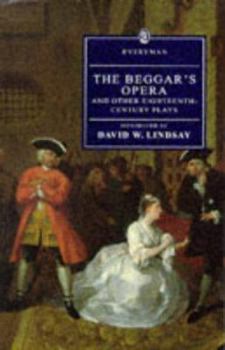
The Beggar's Opera and Other Eighteenth-Century Plays


Part of the Everyman series which has been re-set with wide margins for notes and easy-to-read type. Each title includes a themed introduction by leading authorities on the subject, life-and-times... This description may be from another edition of this product.
Format:Paperback
Language:English
ISBN:0460873148
ISBN13:9780460873147
Release Date:January 1995
Publisher:Tuttle Publishing
Length:543 Pages
Weight:0.79 lbs.
Dimensions:1.6" x 5.2" x 7.8"
Customer Reviews
1 rating
Good Selection - Helpful Introduction, Biographical Notes, and Literary Chronology
Published by Thriftbooks.com User , 18 years ago
The Beggar's Opera and Other Eighteenth Century Plays illustrates the historical development of English drama in the period 1708-1780. The editor, David W. Lindsay suggests that these seven plays might be categorized as a neo-classical tragedy, a sentimental comedy, a ballad-opera, a dramatic burlesque, a bourgeois tragedy, a laughing comedy, and a satirical comedy. Be that as it may (I am no expert on the subtleties of genre), I certainly enjoyed this wide ranging collection. Cato (1713): The Roman senator, Cato, stubbornly resisted Julius Caesar's rise to power. Joseph Addison's play focuses on the last days of Cato's life in north Africa as Caesar's forces approach. Cato ultimately commits suicide rather than surrender. This play was popular for decades, and became a literary inspiration for the American Revolution. Audiences today, however, may find Addison's effusive praise of Cato's political virtue to be excessive. Four stars. The Conscious Lovers (1722): In the prologue Sir Richard Steele states his objective: "To chasten wit, and moralize the stage" and to "Redeem from long contempt the comic name". Steele strives to instruct and to ennoble rather than to amuse. The virtuous Bevil Junior would marry Lucinda whom he does not love rather than disobey his father, Sir John Bevil. His behavior towards the Indiana, the woman he does love, is exceedingly Platonic. He refuses a challenge to duel as it would be morally wrong. Humor is clearly subordinate to instruction. Two stars. The Beggar's Opera (1728): John Gay's rollicking, rowdy lyrics overlain on traditional English ballads and sentimental melodies had extraordinary appeal. Although having only three acts, The Beggar's Opera has some forty-five scenes, almost all with musical interludes. Breaking tradition, the cast was comprised of cutthroats, pickpockets, thieves, streetwalkers, and highwaymen. Five stars. The Tragedy of Tragedies (1731): Henry Fielding's three-act, madcap comedy ridicules contemporary tragedies; simultaneously, its copious footnotes parody eighteenth century literary criticism. The courageous hero and killer of giants, the diminutive Tom Thumb, is beloved by all, even passionately so by the King's daughter, and the King's wife as well. His tragic death - swallowed by a bovine - has few parallels. Four stars. The London Merchant (1731): George Lillo's play is based on a popular ballad that recalled a notorious crime from the previous century. The honest, young merchant apprentice George Barnwell was captivated by the charms of a calculating, amoral, woman of pleasure, Mrs. Millwood, and was persuaded to embezzle money from his employer. Murder follows. The London Merchant was a resounding success; its repetitious moral lessons and its laudatory attitude toward commercial trade resonated with eighteenth century audiences. Three stars. She Stoops to Conquer (1773): The basic theme is familiar. Her guardians, her father Mr. Hardcastle and her aunt Mrs. Hardcastle
Copyright © 2026 Thriftbooks.com Terms of Use
| Privacy Policy | Do Not
Sell/Share My Personal Information | Cookie Policy | Cookie Preferences | Accessibility Statement
ThriftBooks® and the ThriftBooks® logo are registered trademarks of Thrift Books Global, LLC
ThriftBooks® and the ThriftBooks® logo are registered trademarks of Thrift Books Global, LLC
