


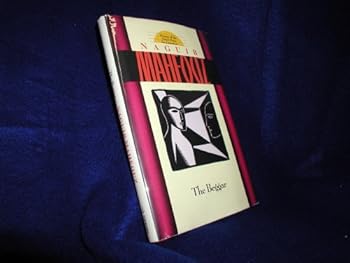
The Beggar


Select Format
Select Condition 
Book Overview
Doubleday
Format:Hardcover
Language:English
ISBN:0385264550
ISBN13:9780385264556
Release Date:July 1990
Publisher:Doubleday Religious Publishing Group, The
Length:140 Pages
Customer Reviews
3 ratings
What This Novella Might Have Meant to Egyptians...
Published by Thriftbooks.com User , 17 years ago
... is totally beyond my ken. Forgive me if I fall back on "post-modernist" justifications for offering a culture-bound Euro-American response to it, a la Derrida, taking myself as an equal partner in the creation of dialogue. I had just finished reading Palace Walk, the first of Mahfouz's Cairo Trilogy, and finding it unexpectedly unsatisfactory, when I noticed this thin novella The Beggar on my bedside to-be-read shelf. I have no idea how long it had stood there... years perhaps. Since my review of Palace Walk had unfocused on unasked questions in Mahfouz's writing, I felt a guilty urge to give the "only Arabic-language Nobel prize Winner" at least a second chance to excite me. And he did! I read this 130-page existential parable straight through, by night light, while my wife murmured disgruntledly in her sleep. Editor John Rodenbeck declares in his foreword that Mahfouz had finished the Cairo Trilogy before 1952, the year of Gamal Abdul Nasser's revolutionary coup d'etat, and that Mahfouz wrote nothing at all for the next five years, before suddenly erupting in a series of 'experimental' novels of which The Beggar is one. I'm led to believe that Mahfouz himself suddenly discovered the very same unasked questions about "the meaning of life" that were so obviously missing from his rambling narrative of family strife, and that Omar, the only actualized personage in The Beggar, is a stand-in for the author in asking those questions: what is worthwhile? does God exist? if so, what is He? what do I do now, having done nothing of worth so far? what would it be like to be truly happy? why do I care so much about happiness? Omar is on one level merely an ordinary male in mid-life crisis, but his crisis is a synecdoche of the human crisis of anomie and alienation that beseiges 'modern man.' Going one post-modernist step farther, as a Western reader, I can't help seeing Omar as Egypt personified, and thus seeing Omar and his two friends - the disillusioned artist and the irremediable dissident - as the Three Directions open to Egyptian society in its reformed irrelevance to the larger world. It was a hopeless cause, Mahfouz's effort to fathom Egypt's 'soul' in the borrowed structure of the classic European novel. To my mind, the Cairo Trilogy belongs on a shelf with Galsworthy and Michener, a saga not unlike the Nile in the dry season, miles wide and inches deep. The Beggar is just as much a European novella, but frankly and effectively so, a modern dilemma treated in a globalized interior-consciousness format. The ending is feeble; Mahfouz perhaps never quite mastered his craft, and fell back on formulaic ellipses and fragments to suggest mental chaos. But the intensity of the writing crests higher than any flaws of literary control. Mahfouz did well to stop writing for those five years. The gestation brought maturity to his writing.
Description of conflicts within self and society
Published by Thriftbooks.com User , 23 years ago
Set in Cairo in the early 1950s, this novel portrays the psychological torment of Omar, an ardent revolutionary in his youth who in middle age has been left behind by Nasser's 1952 Revolution. His conscience has died. As he struggles for psychological renewal, he gives up his work and his family to a series of love affairs, which simply increase his alienation from himself and from the rest of the world. In The Beggar, the lawyer Omar seems confined in his uneventful life. The doctors are helpless; as he seems in good health, but he is being eaten away by anxiety and a feeling of futility. As a way of escape, he sets out to experience everything that goes against norms of respectable married life, he in hope of discovering his illness; looses himself in himself in licentiousness and sexual pleasure . However, his nightly adventures themselves disappear in the morning light, and he remains absent to the world. He wishes to be in the heart of a lover -- he seems to have become a dead man among the living. Even when he meets his old friend the militant leftist Osman Khalil as the latter leaves prison, he cannot find himself again. He admires the energy of his friend, whose militant ardour years in prison have done nothing to cool, but he, Omar El-Hamzaoui, is undermined from within, like a body that has neither natural impulses nor desire. A dead beggar among the living, he now calls upon death to give him a taste for living again and the feeling that he belongs in the world. The value of The Beggar does not lie in the dialogue it contains about the superiority of science over art in the technological age, which is a theme that is in any case exhausted. Instead, it lies in the fact that this novel introduced the Arab reader to the opposition between nihilism, or a life without horizons, and the belief that the world and society are open to change. In this novel, the latter belief is no longer tenable, being neither as full nor as positive as reforming discourse would have it be. Instead, the 1960s citizen has discovered his insignificance in the face of the nationalist State's repressive machinery. Not even free to be himself, he is forced into evasion, silence and the silencing of his conscience.
A STORY ON LEAVING OFF THE WORLD
Published by Thriftbooks.com User , 25 years ago
As it always occurs with Mahfouz, he has brilliantly built the feelings and reasons of a common man to let himself leave off his everyday and "normal" life, in the pursue of something that, at the beginning, not even he himself knows. Boredom and insatisfaction is all he got from his surroundings, work, family. The search for "feeling alive" became an interior struggle which ends with the birth of a "beggar". The climax of the story is admirably led by Mahfouz, who, once more, had gifted us with a very human and touching tale. I recommend this title as one that no one can miss, especially if one is a fan of Nobel Prize's Mahfouz. I give it 4 stars only, because I have read better books of his from the same period, but this do not diminishes the value of this one.
Copyright © 2026 Thriftbooks.com
Terms of Use | Privacy Policy | Do Not Sell/Share My Personal Information | Cookie Policy | Cookie Preferences | Accessibility Statement
ThriftBooks ® and the ThriftBooks ® logo are registered trademarks of Thrift Books Global, LLC
ThriftBooks ® and the ThriftBooks ® logo are registered trademarks of Thrift Books Global, LLC
