


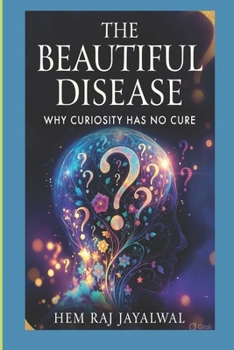
THE BEAUTIFUL DISEASE: WHY CURIOSITY HAS NO CURE
No Customer Reviews

THE BEAUTIFUL DISEASE
WHY CURIOSITY HAS NO CURE
The Cure for Boredom Is Curiosity. There Is No Cure for Curiosity is a philosophical exploration of the most persistent and defining trait of the human mind-the inability to stop asking questions. This book examines curiosity not as a simple virtue but as a complex, often contradictory force that shapes how we think, feel, and live.
The journey begins with boredom-not as emptiness, but as a signal. A quiet unrest that emerges when the mind is under-engaged, not under-stimulated. In a world overflowing with distractions, true boredom has become rare, replaced by shallow engagement that mimics curiosity without ever satisfying it. The book challenges the illusion that constant consumption equals inquiry, revealing how modern life has engineered a simulation of curiosity-fast, endless, and ultimately hollow.
From there, the narrative moves inward, exploring how curiosity begins. A single "why" disrupts certainty and opens a path into the unknown. It traces the transformation of curiosity across life-from the fearless questioning of childhood to the often-suppressed curiosity of adulthood. It argues that curiosity is not something we lose, but something we learn to silence-and that reclaiming it requires courage.
The book also explores the darker dimensions of curiosity. It examines how curiosity can become obsessive, how it can ignore ethical boundaries, and how it has historically been used to justify harm. Not all curiosity is innocent, and the line between exploration and exploitation is thin. The reader is invited to confront this complexity, recognising that curiosity without compassion can become destructive.
At the same time, the book celebrates curiosity as the engine of growth. It shows how every answer leads to more questions, how discovery expands rather than resolves uncertainty, and how the horizon of understanding always moves forward. Through science, personal reflection, and cultural analysis, it demonstrates that curiosity is not about reaching conclusions-but about refining the questions we ask.
The concept of a "cure" is ultimately dismantled. There is no final answer, no endpoint where curiosity rests. Instead, the book reframes curiosity as a lifelong condition-one that can be carried well or poorly. It offers practical insights into sustaining curiosity: protecting it from complacency, nurturing it through habits, and balancing it with the demands of everyday life.
The later sections explore curiosity at a societal level. It examines how innovation, science, and progress depend on cultures that encourage questioning-and how education systems can either nurture or suppress this impulse. It also addresses "dangerous questions"-those that challenge power, disrupt systems, and carry real consequences. These questions, while risky, are essential for transformation.
In its final movement, the book turns toward acceptance. A life without curiosity may be stable, but it is also limited. A curious life, by contrast, is restless, unfinished, and deeply alive. The reader is invited to choose-not between comfort and discomfort, but between closure and openness.
The book ends without a conclusion, reflecting its central truth: curiosity does not end. It continues beyond the final page, leaving the reader not with answers, but with a renewed relationship to the unknown.
This is not a book about solving curiosity.
It is a book about living with it.
Curiosity begins as a cure for boredom-but what happens when it refuses to be cured? This book explores the restless force that drives questions, disrupts certainty, and keeps the mind alive. Moving through boredom, distraction, obsession, and wonder, it reveals curiosity as both a burden and a gift.
WHY CURIOSITY HAS NO CURE
The Cure for Boredom Is Curiosity. There Is No Cure for Curiosity is a philosophical exploration of the most persistent and defining trait of the human mind-the inability to stop asking questions. This book examines curiosity not as a simple virtue but as a complex, often contradictory force that shapes how we think, feel, and live.
The journey begins with boredom-not as emptiness, but as a signal. A quiet unrest that emerges when the mind is under-engaged, not under-stimulated. In a world overflowing with distractions, true boredom has become rare, replaced by shallow engagement that mimics curiosity without ever satisfying it. The book challenges the illusion that constant consumption equals inquiry, revealing how modern life has engineered a simulation of curiosity-fast, endless, and ultimately hollow.
From there, the narrative moves inward, exploring how curiosity begins. A single "why" disrupts certainty and opens a path into the unknown. It traces the transformation of curiosity across life-from the fearless questioning of childhood to the often-suppressed curiosity of adulthood. It argues that curiosity is not something we lose, but something we learn to silence-and that reclaiming it requires courage.
The book also explores the darker dimensions of curiosity. It examines how curiosity can become obsessive, how it can ignore ethical boundaries, and how it has historically been used to justify harm. Not all curiosity is innocent, and the line between exploration and exploitation is thin. The reader is invited to confront this complexity, recognising that curiosity without compassion can become destructive.
At the same time, the book celebrates curiosity as the engine of growth. It shows how every answer leads to more questions, how discovery expands rather than resolves uncertainty, and how the horizon of understanding always moves forward. Through science, personal reflection, and cultural analysis, it demonstrates that curiosity is not about reaching conclusions-but about refining the questions we ask.
The concept of a "cure" is ultimately dismantled. There is no final answer, no endpoint where curiosity rests. Instead, the book reframes curiosity as a lifelong condition-one that can be carried well or poorly. It offers practical insights into sustaining curiosity: protecting it from complacency, nurturing it through habits, and balancing it with the demands of everyday life.
The later sections explore curiosity at a societal level. It examines how innovation, science, and progress depend on cultures that encourage questioning-and how education systems can either nurture or suppress this impulse. It also addresses "dangerous questions"-those that challenge power, disrupt systems, and carry real consequences. These questions, while risky, are essential for transformation.
In its final movement, the book turns toward acceptance. A life without curiosity may be stable, but it is also limited. A curious life, by contrast, is restless, unfinished, and deeply alive. The reader is invited to choose-not between comfort and discomfort, but between closure and openness.
The book ends without a conclusion, reflecting its central truth: curiosity does not end. It continues beyond the final page, leaving the reader not with answers, but with a renewed relationship to the unknown.
This is not a book about solving curiosity.
It is a book about living with it.
Curiosity begins as a cure for boredom-but what happens when it refuses to be cured? This book explores the restless force that drives questions, disrupts certainty, and keeps the mind alive. Moving through boredom, distraction, obsession, and wonder, it reveals curiosity as both a burden and a gift.
Format:Paperback
Language:English
ISBN:B0H1GBW31D
ISBN13:9798196466571
Release Date:May 2026
Publisher:Independently published
Length:281 Pages
Weight:0.84 lbs.
Dimensions:9.0" x 0.7" x 6.0"
Customer Reviews
0 rating
Copyright © 2026 Thriftbooks.com
Terms of Use | Privacy Policy | Do Not Sell/Share My Personal Information | Cookie Policy | Cookie Preferences | Accessibility Statement
ThriftBooks ® and the ThriftBooks ® logo are registered trademarks of Thrift Books Global, LLC
ThriftBooks ® and the ThriftBooks ® logo are registered trademarks of Thrift Books Global, LLC
