


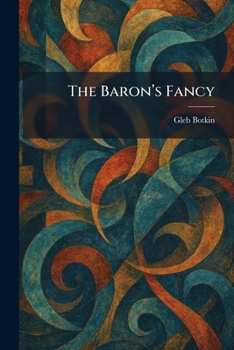
The Baron's Fancy

"The Baron's Fancy" is a compelling novel that explores the dramatic shift of Russian society during the revolutionary era and its aftermath. Written by Gleb Botkin, the story centers on the experiences of the Russian aristocracy as they face the total collapse of their world and the challenges of life in exile. Through the character of Baron de Tzerpinsky, the narrative weaves a tale of irony, satire, and poignant reflection on the nature of status and survival.
The work provides a detailed look at the cultural and political tensions of the early twentieth century, highlighting the divide between the old imperial order and the burgeoning Soviet state. Botkin, drawing from his own deep historical connections to the Russian court, presents a narrative that is as much a social commentary as it is a work of fiction. "The Baron's Fancy" captures the essence of a displaced generation attempting to reconcile their past with an uncertain future. This novel is a valuable piece of historical fiction for readers interested in the human impact of the Russian Revolution and the literary legacy of the Romanov era.
This work has been selected by scholars as being culturally important, and is part of the knowledge base of civilization as we know it. This work was reproduced from the original artifact, and remains as true to the original work as possible. Therefore, you may see the original copyright references, library stamps (as most of these works have been housed in our most important libraries around the world), and other notations in the work.
This work is in the public domain in the United States of America, and possibly other nations. Within the United States, you may freely copy and distribute this work, as no entity (individual or corporate) has a copyright on the body of the work.
As a reproduction of a historical artifact, this work may contain missing or blurred pages, poor pictures, errant marks, etc. Scholars believe, and we concur, that this work is important enough to be preserved, reproduced, and made generally available to the public. We appreciate your support of the preservation process, and thank you for being an important part of keeping this knowledge alive and relevant.
Customer Reviews
ThriftBooks ® and the ThriftBooks ® logo are registered trademarks of Thrift Books Global, LLC
