


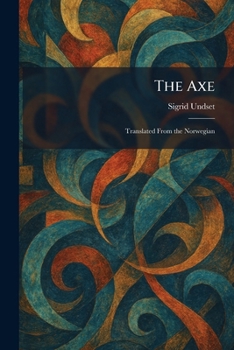
The Axe: Translated From the Norwegian

"The Axe" is the powerful opening volume of Sigrid Undset's epic medieval tetralogy, "The Master of Hestviken". Set in 13th-century Norway, a period of transition between the old Viking codes and the rising influence of Christianity, the novel follows the life of Olav Audunss , n. Betrothed as a child to Ingunn Steinfinnsdatter, Olav finds his destiny inextricably tied to hers, yet their path to union is fraught with exile, violence, and profound moral conflict.
After years spent in Sweden, Olav returns to his homeland to claim his bride and his inheritance at Hestviken, only to be confronted by a devastating secret that leads to a fatal moment of passion and the eponymous act of violence. Undset, a Nobel Prize laureate, meticulously reconstructs the atmosphere of the Middle Ages, exploring themes of honor, guilt, and the spiritual burden of sin. Through the character of Olav, "The Axe" examines the struggle of an individual caught between personal desire and the rigid expectations of family and faith. This masterpiece of historical realism offers a hauntingly beautiful and psychologically complex portrait of life in medieval Scandinavia.
This work has been selected by scholars as being culturally important, and is part of the knowledge base of civilization as we know it. This work was reproduced from the original artifact, and remains as true to the original work as possible. Therefore, you may see the original copyright references, library stamps (as most of these works have been housed in our most important libraries around the world), and other notations in the work.
This work is in the public domain in the United States of America, and possibly other nations. Within the United States, you may freely copy and distribute this work, as no entity (individual or corporate) has a copyright on the body of the work.
As a reproduction of a historical artifact, this work may contain missing or blurred pages, poor pictures, errant marks, etc. Scholars believe, and we concur, that this work is important enough to be preserved, reproduced, and made generally available to the public. We appreciate your support of the preservation process, and thank you for being an important part of keeping this knowledge alive and relevant.
Customer Reviews
ThriftBooks ® and the ThriftBooks ® logo are registered trademarks of Thrift Books Global, LLC
