


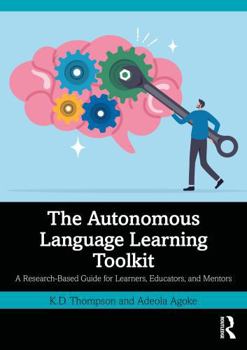
The Autonomous Language Learning Toolkit: A Guide for Learners, Educators, and Mentors

Select Format
Select Condition 
Book Overview
The Automous Language Learning Toolkit presents a research-based framework for designing, supporting, and sustaining fully autonomous language learning. In particular, it focuses on less commonly taught languages in higher education, such as heritage languages, research languages, and languages of fieldwork or diplomacy.
Drawing on a decade of data from sixty learners studying thirty-five languages -- from Swahili and Yoruba to Hmong and beyond -- K.D. Thompson and Adeola Agoke distill what actually works when there is no teacher in the room. Their findings are grounded in a rigorous, multi-year study conducted at the University of Wisconsin-Madison, funded by the U.S. Department of Education, and organized around six essential questions:
1. How do successful autonomous learners set goals?
2. Which strategies build real proficiency?
3. How do learners find and evaluate materials?
4. What does productive mentorship look like?
5. How should learners assess their own progress?
6. How does creating resources deepen learning?
Each chapter translates research findings into practical, adaptable tools for supporting communities of practice and lifelong language learning. Educators and program directors will find an additional appendix offering a complete blueprint for building a self-instructional language program from the ground up.
By foregrounding equity, flexibility, and sustainability, this timely book is an ideal resource for educators and staff in language centres or programmes. It will also be valuable to graduate students and researchers in applied linguistics and second language acquisition, as well as motivated independent learners.
Customer Reviews
ThriftBooks ® and the ThriftBooks ® logo are registered trademarks of Thrift Books Global, LLC
