


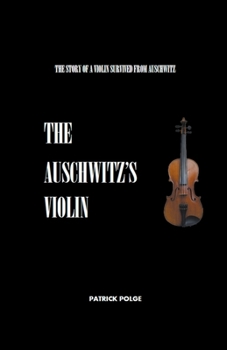
The Auschwitz's violin

Synopsis
THE AUSCHWITZ'S VIOLIN
The story begins in Paris in 1970 with the testimony of a violin born in Mittenwald in one of the oldestviolin makers in Upper Bavaria. The violin remembers his early years in the Hindelmann family. After this prologue of about ten pages, the scene takes place on October 1st, 1946, in Nuremberg, the day of the verdicts of the first international trial against the war crimes of the Nazis.
A few days earlier, Judge Lawrence received a mysterious package stamped with the seals of the German secret service and counterespionage ABWEHR in which he was given a lot of information in documents classified as "defense secrets". The documents submitted for reading by Judge Geoffrey Lawrence, who presided over the Nuremberg trials, constitute indisputable evidence of the existence of documents and secrets hidden by the Third Reich and the surprising revelation of the F?hrer's origins.
A score by Wagner, a composer dear to Hitler, "Twilight of the Gods" is part of the package and leads to archives and secret treasures. Guitta's violin is one of the musical instruments looted by the high dignitaries of the Nazi regime after playing in the Auschwitz orchestra, conducted by Alma Ros?.
Judge Lawrence, initially convinced that these documents were forgeries to undermine the trial, fell into anguish at the sight of an inscription indicating with certainty the veracity of the information he held. He wonders about the outcome of the revelation of the information he has and the consequences for the continuation of the largest trial in human history.
The violin, marked with the initials HG of Guitta, his owner (Hindelmann Guitta) testifies to the dark episode of his life where he played with Guitta in the Auschwitz women's orchestra accompanying the prisoners to the gas chambers. Anastasia who arrives a few months after Guitta, and loses her parents as soon as she arrives sees without aunt Guitta violinist, the meeting is intense but brief. She will never see each other again.
At the death of Guitta, the violin became the object of all lust, first despoiled by Gerigk, Hitler's musicologist, it quickly became an object of reward for the benefit of Giesler, the enemy of Speer, then of Speer himself while Stalin thanked him for his bequest to the Soviet nation. A precious legacy of Hitler's skull and jaw bones that definitively established the power of Stalin and the Soviet Union during the Yalta agreements.
Anastasia, a young teenager, is liberated by the Red Army and courageously begins a painful journey to regain her identity. She arrived in Paris by plane and went from Le Bourget to the Hotel Lut?tia requisitioned under the order of General De Gaulle to welcome the deportees. The narration tells us how the reception of the deportees took place in the heart of the only palace on the Left Bank.
The author then propels us in 1965 in Paris, Hans Lunding, twenty years after the Nuremberg trials, finds Anastasia Hindelmann, who became Anastasia Baskine in Paris.
The novel is a tribute to the victims of the Holocaust and the musical instruments looted by the Nazi regime and the loss of human identity. He reveals to us the paths of rebirth and guiltthrough the moving testimony of the violin. We also discover the corridors of power and the negotiations of Nuremberg and give us the tortured feelings and internal struggles of Nazi dignitaries with excessive egos.
Customer Reviews
ThriftBooks® and the ThriftBooks® logo are registered trademarks of Thrift Books Global, LLC
