


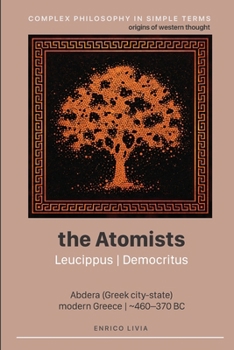
The Atomists: Leucippus, Democritus
No Customer Reviews

Philosophy demands attention. This book invites you to read calmly and offers a clear, structured path -without losing rigor or falling into oversimplification.
Democritus was the most visible face of atomism: curious, prolific, and capable of expanding that doctrine into an extensive reflection on the natural world and human life. He observed human passions from a certain distance and saw how far human beings could produce their own disorder through blindness, excess, and lack of measure. Later authors contrasted him with Heraclitus, who wept at the spectacle of the world; Democritus, by contrast, laughed at that same spectacle.
Through Leucippus and Democritus, atomism proposed that the sensible world could change because simpler structures moved and combined. It thus left behind a possibility that is unsettling and fertile at once: that behind plurality and change there may be an invisible structure capable of making them intelligible.
In this book you'll find: their key ideas explained in their historical contextatoms and void as basic realitiesthe vortex and necessityeuthymia (well-being of the soul without divine reward)a look at their impact on later thoughttheir reflections on the divine, truth, good and evil, and deatha final section of critiques and open questions to deepen the explorationa guide to sources and recommended readings
This volume is part of the series Complex Philosophy in Simple Terms. Each book can be read on its own, but it also connects with the others within a larger journey that traces Western philosophy from its beginnings to the modern search for meaning.
Democritus was the most visible face of atomism: curious, prolific, and capable of expanding that doctrine into an extensive reflection on the natural world and human life. He observed human passions from a certain distance and saw how far human beings could produce their own disorder through blindness, excess, and lack of measure. Later authors contrasted him with Heraclitus, who wept at the spectacle of the world; Democritus, by contrast, laughed at that same spectacle.
Through Leucippus and Democritus, atomism proposed that the sensible world could change because simpler structures moved and combined. It thus left behind a possibility that is unsettling and fertile at once: that behind plurality and change there may be an invisible structure capable of making them intelligible.
In this book you'll find: their key ideas explained in their historical contextatoms and void as basic realitiesthe vortex and necessityeuthymia (well-being of the soul without divine reward)a look at their impact on later thoughttheir reflections on the divine, truth, good and evil, and deatha final section of critiques and open questions to deepen the explorationa guide to sources and recommended readings
This volume is part of the series Complex Philosophy in Simple Terms. Each book can be read on its own, but it also connects with the others within a larger journey that traces Western philosophy from its beginnings to the modern search for meaning.
Format:Paperback
Language:English
ISBN:B0H86HMLTH
ISBN13:9798186464693
Release Date:July 2026
Publisher:Independently Published
Length:58 Pages
Weight:0.18 lbs.
Dimensions:0.1" x 6.0" x 9.0"
Customer Reviews
0 rating
Copyright © 2026 Thriftbooks.com
Terms of Use | Privacy Policy | Do Not Sell/Share My Personal Information | Cookie Notice | Cookie Preferences | Accessibility Statement
ThriftBooks ® and the ThriftBooks ® logo are registered trademarks of Thrift Books Global, LLC
ThriftBooks ® and the ThriftBooks ® logo are registered trademarks of Thrift Books Global, LLC
