


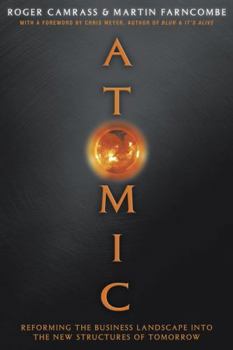
Atomic: Reforming the Business Landscape Into the New Structures of Tomorrow


In Atomic the authors' revolutionary theory is put to the test. Looking across all sectors of business, including retail banking, financial services, telecommunications, IT and consultancy, carbon-based corporations (oil and gas companies), and consumer products companies, Camrass and Farncombe discover some real eye-openers, including how truly more efficient these industries become by a change in corporate structure. The implications for individuals are equally profound and far-reaching. It might take a decade, but it will happen, and nothing will be the same again. Welcome to the Atomic Corporation.
Format:Paperback
Language:English
ISBN:1841121169
ISBN13:9781841121161
Release Date:May 2003
Publisher:Capstone
Length:272 Pages
Weight:0.97 lbs.
Dimensions:0.8" x 6.2" x 9.3"
Customer Reviews
2 ratings
A DIFFERENT LOOK AT BUSINESS STRUCTURES
Published by Thriftbooks.com User , 19 years ago
MESSAGE / CONCEPT Atomic attempts to identify the future business construct based upon trends identified today. Camrass and Farncombe take the analogy of an "atom" that can become part of larger molecules to form value adding business structures. These are more agile and focused organisations than the monolithic businesses today. To their credit, they try to identify those "atoms" rather than just generalise: * Smart Companies. Smart Companies "serve a broad industrial base, and are knowledge-based businesses capitalizing on skills in innovation" [p. 63]. * Webspinners. Webspinners source the suppliers from which the customer wishes to buy. "They own the relationships between suppliers and customers by improving the matching process across the value chain" [p. 64]. * Customer Managers. "The customer portal must capture, confirm, refine and constantly use the customer's views and experiences .... in suggesting offers" [p. 66]. * Asst Platforms. Asset Platforms are the atoms that actually "make" the goods that are offered by the above atoms. * Service Platforms. "Service platforms will take responsibility for organizing common `processes' or all other atoms" [p. 68], such as pay, accounting, administration, etc. * Portfolio Managers. "The principal competency of these atoms is risk taking. Portfolio owners will manage their atoms as a set of investments that are expected to produce returns, maintaining a mix of types of atoms that produces the right profile of risk and reward". They move further than articulating their observations though, and even provide the characteristics that will make a winning "atom" in the future. They are a bit "light on" in terms of statistics to back up their observations, but this doesn't detract from their message, which I must agree from my limited reading and observations, is a very real trend. WHAT I LEARNT I learnt that we are a "Smart Company", a knowledge based business that relies on innovative ideas, methods and techniques to make our way in this ever competitive world. I also feel that the "atomic" business world fits into a broader view of the world - that of complexity [see - http://www.santafe.edu), or perhaps more specifically - social complexity. "Atomisation" would seem to be a construct that is likely to do well in this complex world of self organising entities. Much like a flock of birds in flight that continually changes direction and shape (a complex self organising system), the "atoms" of the future business world will be able to change direction and rearrange themselves again and again to meet the changing tastes and demands of the consumers and customers around them. More importantly, it has validated our approach that puts "knowledge" at the forefront of any business strategy. The future for business rests on how well it can manage its existing knowledge asset, how it can efficiently produce more knowledge suited to its changing context and how it can best leverage t
A Universe in an Atom
Published by Thriftbooks.com User , 24 years ago
The Atomic Corporation is without a doubt a rational proposal for uncertain times. Authors Camrass and Farncombe use `chemistry' as the vehicle to explain their proposition and they do it very well. They show us `a universe within an atom'. They show us why mega corporations will be compelled to break up into smaller business units or `atoms' so that they can become more agile and adaptable to the demands of more powerful consumers. Corporations will devolve into complex and ever changing web of business-to-business connections or `molecules'. In many ways, it supports and confirms our book: Ecosystem: Living the 12 Principles of Networked Business. We use `biology' as our vehicle, instead of chemistry. We both use stakeholder relationships in a holistic manner. We both focus on complexity and collaboration. Where we differ is in perspective. Camrass and Farncombe take the atomic (micro) perspective, whereas we take the ecosystem (macro) perspective and yet we reach not dissimilar conclusions. You cannot afford not to read this book.
Copyright © 2026 Thriftbooks.com Terms of Use
| Privacy Policy | Do Not
Sell/Share My Personal Information | Cookie Policy | Cookie Preferences | Accessibility Statement
ThriftBooks® and the ThriftBooks® logo are registered trademarks of Thrift Books Global, LLC
ThriftBooks® and the ThriftBooks® logo are registered trademarks of Thrift Books Global, LLC
