


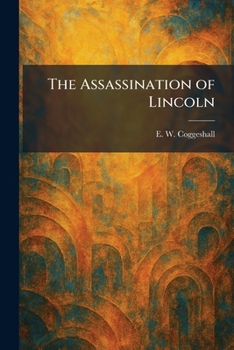
The Assassination of Lincoln

Select Format
Select Condition 
Book Overview
"The Assassination of Lincoln" by E. W. Coggeshall offers a detailed and poignant exploration of one of the most transformative and tragic events in American history. Written with meticulous attention to the historical record, this work examines the circumstances surrounding the murder of the sixteenth President of the United States at Ford's Theatre. The narrative delves into the conspiracy led by John Wilkes Booth, the immediate aftermath of the shooting, and the profound impact Lincoln's death had on a nation still reeling from the wounds of the Civil War.
Coggeshall provides readers with a focused account of the fateful night of April 14, 1865, and the subsequent manhunt for the conspirators. Beyond a mere timeline of events, the book captures the atmosphere of a country in mourning and the sudden loss of a leader who had successfully navigated the Union through its greatest internal conflict. This work remains a significant contribution to the study of Abraham Lincoln, offering insights into the vulnerability of power and the enduring legacy of a man whose life and death helped define the American identity. It is an essential read for students of history and those interested in the complexities of the mid-19th century United States.
This work has been selected by scholars as being culturally important, and is part of the knowledge base of civilization as we know it. This work was reproduced from the original artifact, and remains as true to the original work as possible. Therefore, you may see the original copyright references, library stamps (as most of these works have been housed in our most important libraries around the world), and other notations in the work.
This work is in the public domain in the United States of America, and possibly other nations. Within the United States, you may freely copy and distribute this work, as no entity (individual or corporate) has a copyright on the body of the work.
As a reproduction of a historical artifact, this work may contain missing or blurred pages, poor pictures, errant marks, etc. Scholars believe, and we concur, that this work is important enough to be preserved, reproduced, and made generally available to the public. We appreciate your support of the preservation process, and thank you for being an important part of keeping this knowledge alive and relevant.
Customer Reviews
ThriftBooks ® and the ThriftBooks ® logo are registered trademarks of Thrift Books Global, LLC
