


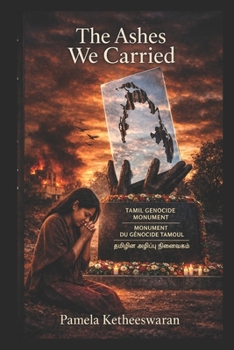
The Ashes We Carried

The Ashes We Carried is a first-person historical novel that follows the life of Kundavai, a Tamil woman born in 1979 in the occupied state of Tamil Eelam, whose life unfolds alongside the escalating violence of the Tamil Genocide in Sri Lanka. Through her perspective, the novel traces the transformation of everyday life into one defined by fear, restriction, and survival, beginning with early structural discrimination and anti-Tamil pogroms, and progressing into full-scale violence and mass atrocities.
The story captures key historical moments, including the burning of the Jaffna Public Library, Black July in 1983, widespread enforced disappearances, and the systematic targeting of Tamil civilians. As Kundavai grows up, she witnesses her community gradually destabilized through state violence, surveillance, and deprivation. Her family becomes her anchor-until the conflict reaches its most devastating phase in Mullivaikkal, where civilians are trapped under continuous shelling, cut off from food, medical aid, and safety.
In Mullivaikkal, survival is reduced to its most basic form. Food is scarce, often limited to thin rice and milk mixtures, medical care is nearly nonexistent, and even designated "safe zones" such as hospitals are no longer protected. The novel details the human cost of these conditions through Kundavai's lived experience-loss, displacement, and the destruction of family and identity.
After the war, Kundavai emigrates to Canada, where she rebuilds her life and becomes a human rights lawyer. Her journey shifts from survival to advocacy, as she dedicates herself to seeking justice and preserving the memory of those lost. The novel concludes with the construction of the Tamil Genocide Monument in Brampton, symbolizing remembrance, resilience, and the refusal to allow history to be erased.
Blending personal narrative with historical events, The Ashes We Carried offers a grounded and emotionally resonant account of the Tamil Genocide. It is a story of endurance, loss, and responsibility-centered on one voice, but reflective of a collective experience.
Customer Reviews
ThriftBooks ® and the ThriftBooks ® logo are registered trademarks of Thrift Books Global, LLC
