


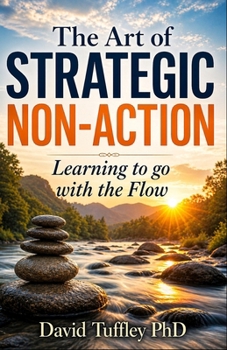
The Art of Strategic Non-Action: Learning to go with the flow

There is a kind of power that Western culture has almost entirely forgotten - and it has nothing to do with force, speed, or relentless striving. It is the power of knowing when not to act.
The Art of Strategic Non-Action is a deceptively compact book with a large idea at its core: that the most effective way to move through the world is often to move less, push less, and resist less. Drawing on the ancient Chinese philosophy of Wu Wei - the concept of effortless action from Lao Tzu's Tao Te Ching, a text so enduring it has remained in continuous print for 2,500 years - David Tuffley translates this wisdom into a practical, modern guide for anyone navigating conflict, leadership, relationships, or the general turbulence of contemporary life.
The argument is elegant and, once grasped, impossible to unsee. Newton's Third Law - for every action, an equal and opposite reaction - does not operate only in physics. It operates in every human exchange. When you push, you create resistance. When you blame, you generate defensiveness. When you seek to control, you breed resentment. Strategic non-action is the art of withdrawing that energy, of giving the world nothing to react against, and watching problems that seemed immovable begin to dissolve.
This is not passivity, and Tuffley is careful to say so. It is a disciplined, highly conscious approach to influence - a matter of choosing the precise moment and the minimal effort rather than defaulting to the blunt instrument of direct confrontation. Like a river finding its way through boulders, strategic non-action works by going around rather than through, wearing down resistance with patience rather than force.
The book moves through fourteen chapters, each illuminating a different dimension of the principle. Selflessness - and why putting yourself last paradoxically advances your interests. The Informing Principle in Nature - the deep interconnectedness of all things and what it means to align yourself with it rather than fight it. The danger of over-specialisation, illustrated vividly through the fate of the Dodo and the survival of the pigeon. The extraordinary, underrated power of empathy in de-escalating conflict. The wisdom of recognising things in their beginning - when influence is easiest and requires the least effort.
There are also chapters on leadership and freedom, on maintaining the adaptable, non-judgmental mind of a child well into adult life, and on what it actually means to cultivate intuition as a form of knowledge deeper than anything accumulated through ordinary experience.
Tuffley writes with the authority of an academic and the accessibility of a thoughtful practitioner - someone who has spent forty years testing these ideas against the grain of real life, not merely theorising from a distance. The closing summary distils the entire philosophy into fourteen principles of uncommon clarity, and the appendix adds an unexpected bonus: a guide to recognising the psychopathic personality, for those who need to know which people strategic non-action is simply not designed to manage.
In a world that rewards aggression and celebrates the relentless doer, The Art of Strategic Non-Action is the quiet, radical argument for a different approach entirely. Read it once and you will rethink every conflict you are currently losing. Read it twice and you may realise you were never meant to fight in the first place.
Customer Reviews
ThriftBooks ® and the ThriftBooks ® logo are registered trademarks of Thrift Books Global, LLC
