


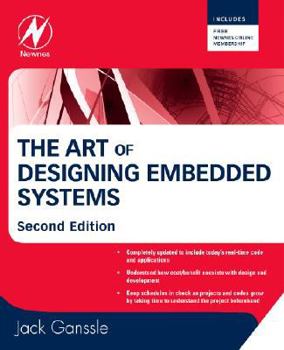
The Art of Designing Embedded Systems

Select Format
Select Condition 
Book Overview
Jack Ganssle has been forming the careers of embedded engineers for 20+ years. He has done this with four books, over 500 articles, a weekly column, and continuous lecturing. Technology moves fast and since the first edition of this best-selling classic much has changed. The new edition will reflect the author's new and ever evolving philosophy in the face of new technology and realities. Now more than ever an overarching philosophy of development is needed before just sitting down to build an application. Practicing embedded engineers will find that Jack provides a high-level strategic plan of attack to the often times chaotic and ad hoc design and development process. He helps frame and solve the issues an engineer confronts with real-time code and applications, hardware and software coexistences, and streamlines detail management. CONTENTS: Chapter 1 - IntroductionChapter 2 - The ProjectChapter 3 - The CodeChapter 4 - Real TimeChapter 5 - The Real WorldChapter 6 - Disciplined DevelopmentAppendix A - A Firmware StandardAppendix B - A Simple Drawing SystemAppendix C - A Boss's Guide to Process
Format:Paperback
Language:English
ISBN:0750686448
ISBN13:9780750686440
Release Date:May 2008
Publisher:Newnes
Length:312 Pages
Weight:1.60 lbs.
Dimensions:0.8" x 7.6" x 9.2"
Customer Reviews
5 ratings
Very good.. but not for beginners
Published by Thriftbooks.com User , 22 years ago
This is a very good book... but it is meant for people with experience in the industry.... the book is about industry and the dynamics within it...not for "student" who are just in college/univ.excelent book once you've had at least 6 months industry experience
Heartily recommend to folks starting in embedded systems
Published by Thriftbooks.com User , 23 years ago
This is a great book for folks who are starting out in embedded systems - a solid overview with practical advice that can be applied throughout one's career. Jack Ganssle also writes for Embedded Systems Programming mag, providing a lot of useful info in an entertaining and lively manner. Good technical writing is tough to come across - he does a wonderful job.
Good Experience From One Who Has Been There
Published by Thriftbooks.com User , 25 years ago
In Mr. Ganssle's book he states, "Engineers are notoriously poor communicators..." and some of that truth shows in his book. The chapters, sections, and appendices are well organized but the content in them is not. The writing style has a tendency to ramble like a friendly conversation, sometimes deviating into tangential material. However, the experience and wisdom held in the book's content (even the tangential parts) are its greatest prize. As an embedded developer with seven years of experience, I found myself frequently relating to the author's own experience. When I read the sentence, "We've got to avoid quoting a long, arbitrary time impact as a knee-jerk reaction to any change request." I actually laughed out loud. Mr. Ganssle does a good job of contrasting a disciplined, well-documented development process versus a panicked, haphazard one and he explains the trade-offs between the two by quoting respectable studies on the subject. The material on writing and debugging good embedded code is all stuff that most folks will, hopefully, learn after few years on the job. But, if you're just starting out, or if you're looking for a better way to do your job, I recommend that you read this book.
Embedded Systems Guru Knowledge Base
Published by Thriftbooks.com User , 25 years ago
This text is obviously a distillation of many years of experience in the field. I have programmed enough ISR's and programmable devices to know that it is very good advise indeed. The book, however, is not for the beginner. His assumed audience are people who are already in the field and would like to take advantage someone with greater experience. The book is loaded with hard learned nuggets of wisdom that are less likely to be found in classroom textbooks. He has something to offer both software and hardware types(I'm software). For example, the advise about software partitioning, ISR development and debugging, and device programming is excellent, and for hardware types the advise on building boards that are both software and hardware debuggable and the myriad tips on finding problems from the common to the obscure will be appreciated. He also provides suggested project management guidelines that help in getting functionality operating as quickly as possible, and, from my point of view, guidance on how to deal with irrational schedules and managements that are reluctant to provide adequate project resources. I appreciated expecially his citing research that quiet private offices provide the single greatest boost to engineering productivity. Probably the only thing I found lacking in the book was a Bibliography of other book references and useful web links.
Great Design Tips
Published by Thriftbooks.com User , 25 years ago
There are many embedded books that will take you real deep and never let you come up for air - this one helps you stay afloat (and awake). Yes, the book organization may not seem to be in perfect order - I have only found a few that were. But, the main difference that sets this book apart is the insight to problems in designing a system - especially the bug's that might creep up later in software. Here, the author gives his experience on how to design embedded systems not build them (there is a difference). Practical advice is presented that may save time, your system, and headaches.
Copyright © 2026 Thriftbooks.com Terms of Use
| Privacy Policy | Do Not
Sell/Share My Personal Information | Cookie Policy | Cookie Preferences | Accessibility Statement
ThriftBooks® and the ThriftBooks® logo are registered trademarks of Thrift Books Global, LLC
ThriftBooks® and the ThriftBooks® logo are registered trademarks of Thrift Books Global, LLC
