


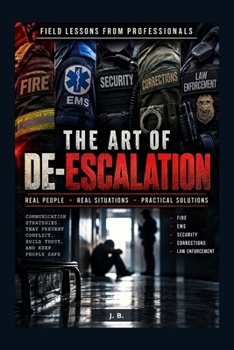
THE ART OF DE-ESCALATION: FIELD LESSONS FROM PROFESSIONALS

De-escalation sounds simple in a classroom. It is a different story when someone is screaming in your face, threatening violence, or refusing to listen.
What do you do when an angry patient is ready to fight? When a teenager in a correctional facility challenges your authority? Or when the people who are supposed to be helping are actually making the situation worse?
The Art of De-Escalation takes readers into the realities of conflict management through firsthand experiences in firefighting, emergency medical services, hospital security, juvenile corrections, and casino surveillance.
Drawing from years of dealing with people during some of the worst moments of their lives, J.B. examines the psychology behind human behavior, the importance of communication, and the techniques that can prevent confrontations from becoming physical.
The book covers practical verbal de-escalation, body language, situational awareness, establishing boundaries, recognizing psychological distress, and knowing when words are no longer enough.
Along the way, readers encounter actual situations, including violent psychiatric patients, confrontations in juvenile corrections, workplace failures, and an angry emergency-room patient whose entire attitude changed over coffee, sandwiches, and a little common sense.
Each experience provides practical lessons, including what worked, what failed, and what could have been handled differently.
Written for security officers, correctional staff, firefighters, EMS personnel, law enforcement professionals, and anyone who regularly encounters conflict, this book offers a practical perspective on keeping situations under control without unnecessarily escalating them.
There are no guarantees in de-escalation. Not everyone can be talked down, and no technique works every time.
But knowing what to say, how to carry yourself, and when to change your approach can make a difference.
Sometimes the most important tool you have is knowing how to talk to another human being.
Customer Reviews
ThriftBooks ® and the ThriftBooks ® logo are registered trademarks of Thrift Books Global, LLC
