


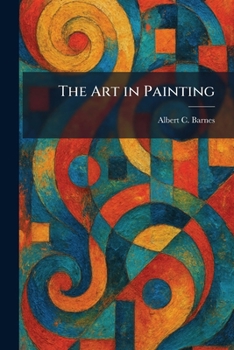
The Art in Painting

Select Format
Select Condition 
Book Overview
"The Art in Painting" is a seminal work by Albert C. Barnes that offers a rigorous and systematic approach to the appreciation and understanding of painting. Drawing upon his extensive collection and deep study of art history, Barnes introduces a method of analysis focused on the plastic elements of a work-color, line, space, and mass-rather than its illustrative or narrative content. This formalist approach aims to provide the viewer with the tools necessary to perceive the aesthetic quality of a painting through a scientific lens, bridging the gap between psychology and art.
The book explores the evolution of painting from its early European roots through the Renaissance and into the modern era, examining the work of masters such as Tintoretto, El Greco, Renoir, and C zanne. Barnes emphasizes the importance of direct experience and the cultivation of visual literacy, arguing that the true value of art lies in its ability to reorganize human experience. As an influential treatise on art education and criticism, "The Art in Painting" remains a foundational text for students, scholars, and art enthusiasts seeking a deeper connection to the visual arts.
This work has been selected by scholars as being culturally important, and is part of the knowledge base of civilization as we know it. This work was reproduced from the original artifact, and remains as true to the original work as possible. Therefore, you may see the original copyright references, library stamps (as most of these works have been housed in our most important libraries around the world), and other notations in the work.
This work is in the public domain in the United States of America, and possibly other nations. Within the United States, you may freely copy and distribute this work, as no entity (individual or corporate) has a copyright on the body of the work.
As a reproduction of a historical artifact, this work may contain missing or blurred pages, poor pictures, errant marks, etc. Scholars believe, and we concur, that this work is important enough to be preserved, reproduced, and made generally available to the public. We appreciate your support of the preservation process, and thank you for being an important part of keeping this knowledge alive and relevant.
Customer Reviews
ThriftBooks® and the ThriftBooks® logo are registered trademarks of Thrift Books Global, LLC
