


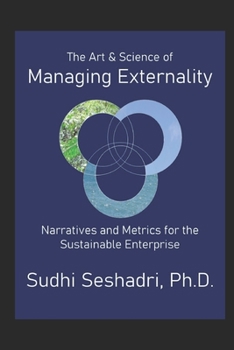
The Art & Science of Managing Externality: Narratives & Metrics for the Sustainable Enterprise
No Customer Reviews

This book aims to help clarify and define the negotiation space and process between four audiences that are justifiably vocal on environmental planning and the climate crisis. These audiences emerge from (i) Civil society organizations including NGOs, students, and academics; (ii) Financial services executives, investors, and asset managers; (iii) Business managers at all levels - Boards, CXOs, executives, and their Business Associations; and (iv) Policy-makers from government and a variety of administrative bodies and agencies charged with overseeing Community Welfare as well as Corporate Affairs. The internal benefits for one audience impose external costs on another - and the book focuses on such "externality" in its many forms.
With these audiences in mind, it historicizes and develops integrating themes related to externality - climate change, business ethics, Corporate Social Responsibility (CSR), Environment-Social-Governance (ESG), Financial Statements for transitions to sustainability, Financial System & Market System policy response.
Each has been dealt with in the past with its own narrative of theory and practice, independent of the others. In contrast, this book integrates these themes. Moreover, rarely have they been treated as interlocking systems of metrics, including those at the enterprise level.
The book is a genre-crossing sourcebook based on the belief that climate catastrophe and environmental concerns can be averted only when multiple stakeholders build inter-organizational enterprise models. Towards this goal, the narratives and metrics in the book form a basis to negotiate often deeply conflicting positions. Enhancing the capability for such negotiation is a global imperative.
With these audiences in mind, it historicizes and develops integrating themes related to externality - climate change, business ethics, Corporate Social Responsibility (CSR), Environment-Social-Governance (ESG), Financial Statements for transitions to sustainability, Financial System & Market System policy response.
Each has been dealt with in the past with its own narrative of theory and practice, independent of the others. In contrast, this book integrates these themes. Moreover, rarely have they been treated as interlocking systems of metrics, including those at the enterprise level.
The book is a genre-crossing sourcebook based on the belief that climate catastrophe and environmental concerns can be averted only when multiple stakeholders build inter-organizational enterprise models. Towards this goal, the narratives and metrics in the book form a basis to negotiate often deeply conflicting positions. Enhancing the capability for such negotiation is a global imperative.
Format:Paperback
Language:English
ISBN:B09GZSXTKL
ISBN13:9798743004034
Release Date:September 2021
Publisher:Independently Published
Length:486 Pages
Weight:1.42 lbs.
Dimensions:1.0" x 6.0" x 9.0"
Customer Reviews
0 rating
Copyright © 2026 Thriftbooks.com Terms of Use
| Privacy Policy | Do Not
Sell/Share My Personal Information | Cookie Policy | Cookie Preferences | Accessibility Statement
ThriftBooks® and the ThriftBooks® logo are registered trademarks of Thrift Books Global, LLC
ThriftBooks® and the ThriftBooks® logo are registered trademarks of Thrift Books Global, LLC
