


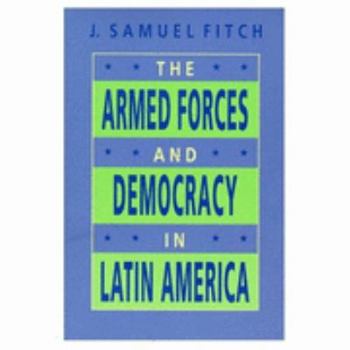
The Armed Forces and Democracy in Latin America

The political role of the military is one of the most important questions facing Latin American societies seeking to consolidate new democracies. Despite the return to elected civilian governments, undemocratic patterns of civil-military relations persist in much of the region. Still, the political power of the armed forces is varied and often less dominant than expected. In key countries, military influence is declining, although effective democratic control of the military remains elusive. In The Armed Forces and Democracy in Latin America, J. Samuel Fitch analyzes the contrasting patterns of military power in post-transition regimes. Drawing on a wide range of sources, he shows how learning from the past, the domestic environment, and the international context affect military beliefs about their role in politics. His analysis includes policy recommendations for U.S. and Latin American leaders trying to promote democratic civilian-military relations.
Format:Paperback
Language:English
ISBN:0801859182
ISBN13:9780801859182
Release Date:January 1998
Publisher:Johns Hopkins Univ Pr
Length:264 Pages
Weight:0.90 lbs.
Dimensions:9.3" x 0.8" x 6.3"
Customer Reviews
1 rating
Excellent research and very readable
Published by Thriftbooks.com User , 26 years ago
The details of this book are suberbly summarized in the previous review so I won't bother duplicating this effort. I do disagree with the previous reviewer's assessment of the book, which is at best very simplistic and at worst very weak. Indeed Fitch primarily relies on his careful examination of the armed forces in Argentina and Ecuador (where he has done most of his fieldwork) but he also synthesizes very well the growing case-study literature on the armed forces in Brazil, Honduras, Chile, Peru, Uruguay and Guatemala. This allows him to validly and reliably draw conclusions about the armed forces in all of Latin America. Few studies of Latin American militaries have analyzed such a wide range of countries. Studying the armed forces (a closed political institution) is no easy task and Fitch should be commended for the important insights that he offers in this book. To argue that he should have expanded the size of his sample is logical but given resource constraints (funds and time, especially) this is a very daunting task. Fitch's book is unique in the careful and systematic attention it pays to military attitudes. According to one scholar, "The [book's] focus on attitudes serves as a useful and refreshing complement to the predominant institutionalist orientation of current work on Latin American militaries." Fitch also makes a significant contribution to policy-makers in this book by discussing specific measures that civilian governments can implement to help democratize the military and normalize relations between civilians and military officials. In all, this book is a good read for students, scholars and policy-makers.
Copyright © 2026 Thriftbooks.com Terms of Use
| Privacy Policy | Do Not
Sell/Share My Personal Information | Cookie Policy | Cookie Preferences | Accessibility Statement
ThriftBooks® and the ThriftBooks® logo are registered trademarks of Thrift Books Global, LLC
ThriftBooks® and the ThriftBooks® logo are registered trademarks of Thrift Books Global, LLC
