


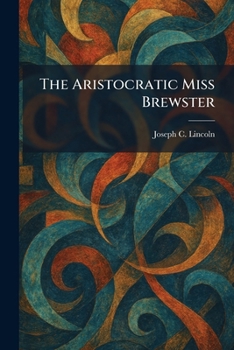
The Aristocratic Miss Brewster

Select Format
Select Condition 
Book Overview
"The Aristocratic Miss Brewster" is a charming and insightful novel set in the close-knit community of Denboro on Cape Cod. The story follows Mary Brewster, a woman of high social standing whose family has long been the pinnacle of local prestige. However, when unforeseen financial difficulties threaten her security, Mary is forced to do the unthinkable for a woman of her class: seek employment. Her decision to work at the local bank sends shockwaves through the tradition-bound town, challenging the rigid social hierarchies of the early 20th century.
As Mary navigates her new reality, Joseph C. Lincoln masterfully captures the unique flavor of New England life, filled with colorful local characters, witty dialogue, and a touch of romance. The narrative explores themes of pride, resilience, and the shifting tides of social expectation. Mary's journey is not just one of economic survival, but of personal growth and the discovery that true worth is not defined by heritage alone. "The Aristocratic Miss Brewster" remains a delightful example of Lincoln's signature regional fiction, blending humor and heart in a picturesque coastal setting.
This work has been selected by scholars as being culturally important, and is part of the knowledge base of civilization as we know it. This work was reproduced from the original artifact, and remains as true to the original work as possible. Therefore, you may see the original copyright references, library stamps (as most of these works have been housed in our most important libraries around the world), and other notations in the work.
This work is in the public domain in the United States of America, and possibly other nations. Within the United States, you may freely copy and distribute this work, as no entity (individual or corporate) has a copyright on the body of the work.
As a reproduction of a historical artifact, this work may contain missing or blurred pages, poor pictures, errant marks, etc. Scholars believe, and we concur, that this work is important enough to be preserved, reproduced, and made generally available to the public. We appreciate your support of the preservation process, and thank you for being an important part of keeping this knowledge alive and relevant.
Customer Reviews
ThriftBooks® and the ThriftBooks® logo are registered trademarks of Thrift Books Global, LLC
