


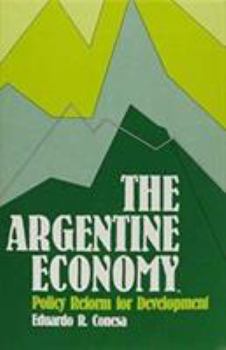
The Argentine Economy: Policy Reform for Development
No Customer Reviews

The decay of Argentina remains the puzzle of the last 50 years of international development. This book explains why the decay, and, more important, how to reverse it. Conesa emphasizes the country's lack of institutions to channel the talents of the Argentine people to public administration and government in general. Thus, after 1930 (and particularly after World War II), agricultural protectionism reigned in international trade, while trade in manufactures became increasingly free all over the western world. Argentina, a country extremely well endowed for agricultural production, has not adapted its economic system and incentives to the new world economic conditions of recent decades. This book argues that it is not too late to institute reforms that could strengthen the Argentine economy, allowing the country to grow and to pay the interest of its external debt simultaneously. Contents: 1. Post-1930 Economic Stagnation; 2. The Constraints Imposed by International Agricultura Protectionism; 3. The Exchange Rate Policy; 4. Government Finances and the Exchange Rate; 5. Inflation, Monetary Policy, and External Debt; 6. Long-Term Development and Latin American Integration. Co-published with the Center for International Affairs, Harvard University.
Format:Paperback
Language:English
ISBN:0819174106
ISBN13:9780819174109
Release Date:October 1989
Publisher:University Press Of America
Length:144 Pages
Weight:0.45 lbs.
Dimensions:9.0" x 0.3" x 6.0"
Customer Reviews
0 rating
Copyright © 2026 Thriftbooks.com Terms of Use
| Privacy Policy | Do Not
Sell/Share My Personal Information | Cookie Policy | Cookie Preferences | Accessibility Statement
ThriftBooks® and the ThriftBooks® logo are registered trademarks of Thrift Books Global, LLC
ThriftBooks® and the ThriftBooks® logo are registered trademarks of Thrift Books Global, LLC
