


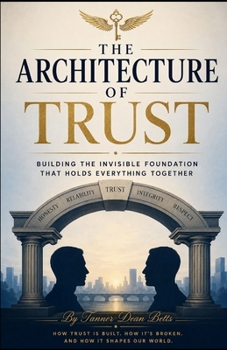
The architecture of Trust: How trust is built. How it is broken. And how it shapes our world

How Civilization Decides Who-and What-to Believe
Trust is the invisible infrastructure of civilization.
Every meaningful relationship, every successful business, every functioning institution, every financial system, and every society depends upon one resource that cannot be seen, measured directly, or manufactured overnight.
Trust.
Without it, marriages become negotiations.
Businesses become contracts.
Governments become surveillance.
Communities become collections of strangers.
Civilization itself begins to fracture.
In The Architecture of Trust, Tanner Dean Betts explores trust not simply as an emotion, but as one of humanity's most important architectural systems. Drawing from psychology, neuroscience, behavioral economics, organizational behavior, philosophy, sociology, leadership, and systems thinking, this book examines how trust is built, why it breaks, how it transfers between people and institutions, and why it remains the foundation beneath every successful civilization.
Rather than treating trust as a matter of personality or morality alone, The Architecture of Trust reveals the deeper structures that allow individuals, families, organizations, markets, and entire societies to cooperate despite uncertainty.
Inside you'll discover:
Why trust begins long before language through childhood attachment.The hidden mathematics behind every act of trust.How friendships, marriages, and families are built on predictable behavior-not perfect behavior.Why trust grows slowly but can collapse almost instantly.How businesses monetize reputation and why credibility has become one of the world's most valuable economic assets.The difference between genuine trust and carefully manufactured appearances.Why institutions fail only after trust begins to disappear.How artificial intelligence, algorithms, and digital identity are changing the future of credibility.Why trust is one of the greatest forms of power a person or organization can possess.Practical principles for designing trustworthy relationships, teams, businesses, and communities.Unlike books that focus solely on leadership, communication, or self-improvement, The Architecture of Trust presents trust as a universal operating system underlying every human interaction-from a parent's first promise to a child to the institutions holding modern civilization together.
This is not simply a book about relationships.
It is a book about the hidden architecture that makes relationships possible.
Whether you're an entrepreneur, executive, educator, psychologist, leader, investor, parent, or simply someone seeking to understand why some people, businesses, and institutions inspire enduring confidence while others slowly lose it, this book offers a powerful new framework for seeing one of civilization's most valuable resources.
Because trust isn't simply something we feel.
It's something we build.
And everything we build afterward depends upon it.
Customer Reviews
ThriftBooks ® and the ThriftBooks ® logo are registered trademarks of Thrift Books Global, LLC
