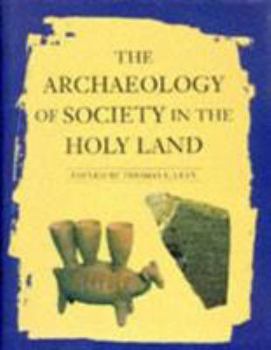
Arch Of Society


Select Format
Select Condition 
Book Overview
This volume marks a departure from earlier descriptive archaeological summaries of the Holy Land. Taking an anthropological and socio-economic perspective, many of the leading archaeologists who work in Israel and Jordan today present timely and concise summaries of the archaeology of this region. Chronologically organized, each chapter outlines the major cultural transitions which occurred in a given archaeological period. To explain the processes which were responsible for culture change, a review is made of the most recent research concerning settlement patterns, innovations and technology, religion and ideology, and social organization. The material culture of every period of human history in the Holy Land is explored from the earliest prehistoric hominids, through the Biblical and historical periods and up to modern (20th century) times. Each chapter is accompanied by settlement pattern maps and a plate highlighting the major artifacts which archaeologists use to identify the material culture of the period. In addition, windows are presented which focus on major social issues and controversies such as "The Agricultural Revolution," the "Israelite Conquest of Canaan" and "Ancient Metal Working and Social Change." This volume should provide students and the general reader with a useful reference volume concerning the archaeology of societies which lived and live in the Holy Land.
Format:Hardcover
Language:English
ISBN:0718513886
ISBN13:9780718513887
Release Date:January 2001
Publisher:Bloomsbury Academic & Professional
Weight:0.66 lbs.
Dimensions:1.1" x 1.1" x 1.1"
Customer Reviews
1 rating
A Survey of Archæological Evidence Reaching Far in the Past
Published by Thriftbooks.com User , 26 years ago
Archæology constitutes a meticulous study of ancient artifacts and residues from periods in human history remote to the modern world. This field of anthropology is marked by differences in emphasis, depending on the region under excavation. In the southern Levant, such focus generally accentuates what has been termed "biblical archæology", designed to augment historical understanding of the scriptures, both the Hebrew Canon and the New Testament. Aside from difficulties inherent in synthsizing descriptions written or edited centuries after the events narrated, often with religious revelations overriding historical "accuracy" (a concept whose importance has been presumed only relatively recently), archæology--being predominantly a material discipline--can interpret only what is physically observable in the present. Recent decades have witnessed profound changes in archæology, expanding beyond the evidence of technological advancement--from Paleolithic hunter-gatherers to Neolithic agriculturists to the Bronze and Iron ages--as well as political demarcations--Canaanite city states, Isrælite monarchies, hegemonies under Persian, Roman or Ottoman rule. Social archæology--intended to examine the culture of the region in question--is the theme in _The_Archæology_of_Society_in_the_Holy_Land_, edited by Thomas E. Levy, professor of Judaic Studies at the University of California, San Diego. The articles cover a wide chronology from the early Paleolithic age to the modern era in terms of material culture, as well as flora, fauna, climate, economy, and manufacture. To preclude an overly narrow focus on Biblical periods, the thirty authors devote over a third of the book to the premetal times. Most of the dates are given in BCE and CE (which I do not appreciate, preferring the more traditional BC and AD), except the prehistoric periods which are rendered BP [before present]. The text is profusely illustrated, not only with photographs of pottery and plaques, but replete with detailed diagrams of excavated sites and shaded relief maps depicting these locations. This collective endeavor has been dedicated to the spirit of Fernand Braudel, the French historian who developed the theory of longue durée or long duration undercurrents which (allegedly) act independently of individual activities for any given span. Although this suggests a somewhat Tolstoyan conceit, the analysis presented renders support to people being influenced by the conditions in which they live. _The_Archæology_of_Society_ begins with a preface describing its interdisciplinary approach weaving anthropology (the study of culture), history (textual criticism of ancient records), geoscience (including climatology and geology), archeometry (artifacts dating, materials identification), and environmental archæology (encompassing botany and zoology). The six parts that follow are further subdivided chronologically into 32 chapters. The climate in
Copyright © 2026 Thriftbooks.com
Terms of Use | Privacy Policy | Do Not Sell/Share My Personal Information | Cookie Notice | Cookie Preferences | Accessibility Statement
ThriftBooks ® and the ThriftBooks ® logo are registered trademarks of Thrift Books Global, LLC