


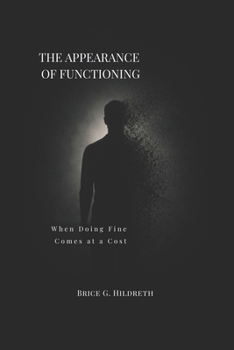
The Appearance of Functioning: When Doing Fine Comes at a Cost

You followed the rules. You showed up. You held it together.
And somehow it still wasn't enough.
If that sentence describes your life - or someone you love, or someone you work with - this book was written for you.
The Appearance of Functioning examines a pervasive but rarely named error running through education, mental health, healthcare, and diagnostic systems: the confusion of performance with capacity.
Many people, particularly those who are neurodivergent, function visibly while absorbing invisible strain. They comply, adapt, and meet external standards - often at significant personal cost. When that cost surfaces as burnout, breakdown, or disappearance from the systems meant to help, the explanation almost always turns inward. The individual is framed as unmotivated, resistant, or failing to apply support.
This book makes a different argument.
Drawing on clinical experience across homeless outreach, community mental health, and private practice with neurodivergent adults, this book traces how the same misunderstanding shapes outcomes across schools, mental health care, healthcare, and social support structures. It explores why neurodivergence is consistently missed or misinterpreted, how well-intentioned interventions produce attrition, and why so many negative outcomes are predictable rather than anomalous.
This is not a self-help book. It is not an argument against accountability or diagnosis or treatment.
It is a reframing - of what functioning actually means, of what neurodivergence looks like across a life, and of where the responsibility for these outcomes actually belongs.
For the clinician who keeps seeing the same people fail the same interventions. For the parent who recognizes their child in descriptions no one has offered before. For the neurodivergent adult who has spent years wondering why trying harder never closed the gap.
And for anyone who has ever been told they were fine, while knowing privately that they were not.
Customer Reviews
ThriftBooks ® and the ThriftBooks ® logo are registered trademarks of Thrift Books Global, LLC
