


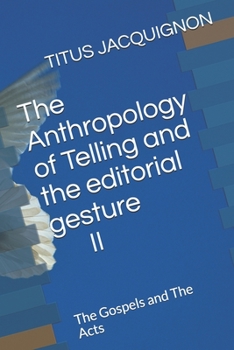
The Anthropology of Telling and the editorial gesture II: The Gospels and The Acts
No Customer Reviews

What do we actually have in our hands and what can we legitimately talk about? We have no ancient works: not an Aristotle, not a Plato, not a Homer, not a Gospel either, etc. All our materials are from the early Middle Ages and the first of them is the codex vaticanus of the year 350, containing the Septuagint and the Gospel in one complete work - nothing below, nothing around. Between Aristotle and the first material document with his name on the cover, seven and a half centuries apart, and so on.The invention of the book is the first codex and the first editorial gesture that we have; it is not a problem correlative to the invention of printing.I looked the ancient void of sources in the face and I drew from it the strategic decision not to betray the void by means of I don't know what "theory"; I placed myself at the date of my materials - our only sources - by refusing to divide the problem of fund, substance, form, design science and the editorial gesture. I have examined the Septuagint and the Gospel together, posing myself in 350, giving primacy to the editorial gesture that the codex represents. I have analyzed the mutation it represents in relation to the mediologies that preceded it and the implications that flow from it. Indeed, if a Roman in the year 200 goes to the library in Rome, asks for a Homer - and knowing that neither the codex nor the complete work is given to him because it does not yet exist - what does he read? Who reads who and what? Nothing of what we have These are books and complete works that we have - what the Ancients did not have - and that changes the game and the problematic. It so happens that the Ancients, as early as late Antiquity, thought editorial gesture and library of complete works of Reference from the moment of conception, and they account for their choices and their work in their Finalized Writings - in the Tellings that speak of their science of conception and their science of problem through the "characters" they use. In order to conduct this survey, we must abandon our current benchmarks and frameworks. They are not Moderns: they don't write like us, they don't read like us, they don't hear like us, they don't reason like us. It then becomes necessary to rediscover their anthropology: their relationship to materials, to Form and writing, their relationship to knowledge, their relationship to learning, their relationship to the fabrication of language, etc. Methodologically, we must accept to become other. We must play their game in order to learn the nature of their game, the rules of the game, and the good behavior of the player on the field - that of no-modern Tellings, which are in no way comparable to our literature. In other words, it is a matter of entering a system without applying anything to it from the outside, in order to crack it directly from the inside. I will draw from the Quran the logical method and tool necessary for the examination of the Quran; I will draw from Genesis the logical method and tool necessary for the examination of Genesis; I will draw from the Gospel the logical method and tool necessary for the examination of the Gospel. No theory, technique, or framework from the Modern world will be applied, from the outside, to my objects of study.
Format:Paperback
Language:English
ISBN:B08NDVKK6Y
ISBN13:9798564205733
Release Date:November 2020
Publisher:Independently Published
Length:750 Pages
Weight:2.17 lbs.
Dimensions:1.5" x 6.0" x 9.0"
Related Subjects
HistoryCustomer Reviews
0 rating
Copyright © 2026 Thriftbooks.com Terms of Use
| Privacy Policy | Do Not
Sell/Share My Personal Information | Cookie Policy | Cookie Preferences | Accessibility Statement
ThriftBooks® and the ThriftBooks® logo are registered trademarks of Thrift Books Global, LLC
ThriftBooks® and the ThriftBooks® logo are registered trademarks of Thrift Books Global, LLC
