


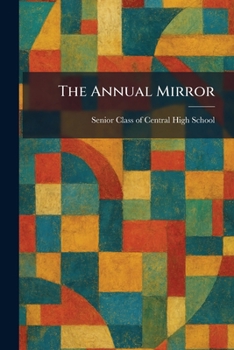
The Annual Mirror

Select Format
Select Condition 
Book Overview
"The Annual Mirror" is a comprehensive yearbook from 1929 that documents the academic year and social life of Central High School. Created by the senior class, this volume serves as a rich historical record of the student body, faculty, and administration during a transformative era in American education. The work includes detailed portraits of the graduating seniors, alongside sections dedicated to underclassmen and staff members.
The pages of "The Annual Mirror" provide a window into the extracurricular landscape of the late 1920s, featuring coverage of athletic teams, musical ensembles, dramatic clubs, and academic societies. Through photographs and descriptive summaries, the book captures the school spirit, traditions, and collective achievements of the community. As a primary source for local history and genealogical research, it preserves the names and faces of a generation on the cusp of adulthood. This annual publication offers an authentic glimpse into the daily experiences, fashion, and social values that defined the high school experience nearly a century ago, making it a valuable artifact of 20th-century Americana.
This work has been selected by scholars as being culturally important, and is part of the knowledge base of civilization as we know it. This work was reproduced from the original artifact, and remains as true to the original work as possible. Therefore, you may see the original copyright references, library stamps (as most of these works have been housed in our most important libraries around the world), and other notations in the work.
This work is in the public domain in the United States of America, and possibly other nations. Within the United States, you may freely copy and distribute this work, as no entity (individual or corporate) has a copyright on the body of the work.
As a reproduction of a historical artifact, this work may contain missing or blurred pages, poor pictures, errant marks, etc. Scholars believe, and we concur, that this work is important enough to be preserved, reproduced, and made generally available to the public. We appreciate your support of the preservation process, and thank you for being an important part of keeping this knowledge alive and relevant.
Customer Reviews
ThriftBooks ® and the ThriftBooks ® logo are registered trademarks of Thrift Books Global, LLC
