


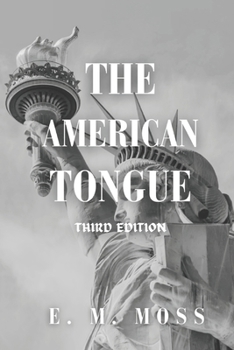
The American Tongue: Third Edition

The American Tongue is a politically and philosophically charged exploration of free speech, democratic culture, individuality, and the psychological condition of modern America. Combining political theory, constitutional analysis, cultural criticism, and philosophical reflection, the book examines the growing tensions between liberty and conformity within an increasingly polarized and emotionally reactive society.
Through discussions surrounding propaganda, censorship, social media, identity politics, outrage culture, and the erosion of nuance, the work confronts the instability of truth and discourse in the digital age. Expanding beyond traditional political commentary, the book explores how modern democratic culture increasingly encourages performance over authenticity, emotional reaction over critical thought, and ideological conformity over intellectual independence.
Drawing from landmark Supreme Court cases such as Chaplinsky v. New Hampshire, Snyder v. Phelps, Roth v. United States, Yates v. United States, and Brandenburg v. Ohio, the text investigates the legal and philosophical boundaries of expression within democratic society. Simultaneously, it engages with the ideas of thinkers such as John Stuart Mill, Alexis de Tocqueville, Friedrich Nietzsche, Hannah Arendt, and Michel Foucault to analyze the relationship between power, morality, individuality, and social control.
The book's later chapters, including The Death of Nuance, The Tyranny of the Majority, Individual Speech as Rebellion, The Psychology of Offense, and The Weaponization of Compassion, expand the discussion into a broader philosophical critique of contemporary culture. These chapters examine the collapse of ambiguity within public discourse, the moralization of politics, the commodification of identity, and the increasing tension between emotional comfort and intellectual freedom.
Provocative and deeply reflective, The American Tongue ultimately argues that the survival of free society depends not merely upon constitutional protections, but upon the willingness of individuals to think independently, tolerate disagreement, and resist the growing pressures of ideological conformity within modern democratic life.
Related Subjects
PhilosophyCustomer Reviews
ThriftBooks ® and the ThriftBooks ® logo are registered trademarks of Thrift Books Global, LLC
