


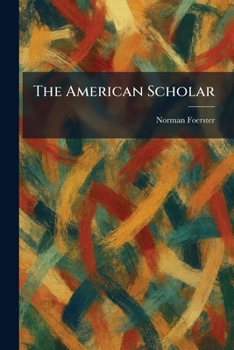
The American Scholar

"The American Scholar" is a significant examination of the state of literary scholarship and the direction of higher education in the early twentieth century. Written by Norman Foerster, a prominent figure in the New Humanism movement, this work addresses the growing divide between scientific, philological research and the interpretive, critical study of literature. Foerster argues that the modern academic landscape has become overly focused on the accumulation of facts at the expense of aesthetic and ethical judgment.
The text serves as a call to action for educators and intellectuals to reclaim a humanistic perspective in the humanities. By analyzing the training of scholars and the standards of graduate study, Foerster seeks to redefine the role of the critic in American society. He advocates for a methodology that balances historical accuracy with a deep engagement with the values and meanings inherent in great literary works. "The American Scholar" remains a vital contribution to the history of American literary theory and provides a foundational perspective on the ongoing debates regarding the purpose of the university and the value of liberal arts education.
This work has been selected by scholars as being culturally important, and is part of the knowledge base of civilization as we know it. This work was reproduced from the original artifact, and remains as true to the original work as possible. Therefore, you may see the original copyright references, library stamps (as most of these works have been housed in our most important libraries around the world), and other notations in the work.
This work is in the public domain in the United States of America, and possibly other nations. Within the United States, you may freely copy and distribute this work, as no entity (individual or corporate) has a copyright on the body of the work.
As a reproduction of a historical artifact, this work may contain missing or blurred pages, poor pictures, errant marks, etc. Scholars believe, and we concur, that this work is important enough to be preserved, reproduced, and made generally available to the public. We appreciate your support of the preservation process, and thank you for being an important part of keeping this knowledge alive and relevant.
Related Subjects
Education Education & Reference Literary Criticism Literary Criticism & CollectionsCustomer Reviews
ThriftBooks ® and the ThriftBooks ® logo are registered trademarks of Thrift Books Global, LLC
