


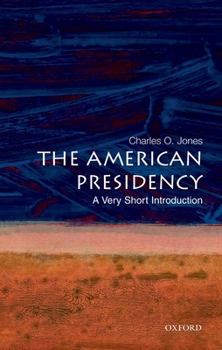
The American Presidency: A Very Short Introduction
(Part of the Very Short Introductions (#165) Series, Oxford's Very Short Introductions series Series, and Very Short Introductions (#165) Series)

Select Format
Select Condition 
Book Overview
The expansion of executive powers amid the war on terrorism has brought the presidency to the center of heated public debate. Now, in The American Presidency, presidential authority Charles O. Jones provides invaluable background to the current controversy, in a compact, reliable guide to the office of the chief executive. This marvelously concise survey is packed with information about the presidency, some of it quite surprising. We learn, for example, that the Founders adopted the word "president" over "governor" and other alternatives because it suggested a light hand, as in one who presides, rather than rules. Indeed, the Constitutional Convention first agreed to a weak chief executive elected by congress for one seven-year term, later calling for independent election and separation of powers. Jones sheds much light on how assertive leaders, such as Andrew Jackson, Theodore Roosevelt, and FDR enhanced the power of the presidency, and illuminating how such factors as philosophy (Reagan's anti-Communist conservatism), the legacy of previous presidencies (Jimmy Carter following Watergate), relations with Congress, and the impact of outside events have all influenced presidential authority. He also explores the rise of federal power and the dramatic expansion of federal agencies, showing how the president takes a direct hand in this vast bureaucracy, and he examines the political process of selecting presidents, from the days of deadlocked conventions to the rise of the primary after World War II. "In 200 years," he writes, "the presidency had changed from that of a person--Washington followed by Adams, then Jefferson--to a presidential enterprise with a cast of thousands." Jones explains how this remarkable expansion has occurred and where it may lead in the future. About the Series: Combining authority with wit, accessibility, and style, Very Short Introductions offer an introduction to some of life's most interesting topics. Written by experts for the newcomer, they demonstrate the finest contemporary thinking about the central problems and issues in hundreds of key topics, from philosophy to Freud, quantum theory to Islam.
Format:Paperback
Language:English
ISBN:0195307011
ISBN13:9780195307016
Release Date:August 2007
Publisher:Oxford University Press
Length:192 Pages
Weight:0.65 lbs.
Dimensions:4.4" x 0.6" x 6.8"
Customer Reviews
1 rating
A Short and Informative Introduction to American Presidency
Published by Thriftbooks.com User , 17 years ago
No aspect of American politics, and certainly no other political office, attracts as much public attention as the office of the President. And yet, at the very founding of the American Republic, this office was nonexistent, and only came about after the realization that the much looser federation was not effective enough as a union. It took two hundred years plus for the presidency to evolve into what it is today: the most powerful political position in the World. The book is particularly good at explaining the nitty-gritty of the actual governing. It goes in some detail to explain all the offices and departments that report directly to the president, and explains their role with ample historical examples. This potentially very dry subject is handled adroitly and made interesting even for readers who may not have much interest in this area. The book is a good companion to the other recent very short introduction book on American politics, American Political Parties and Elections: A Very Short Introduction (Very Short Introductions). The chapters in this book, and the topics covered, are: 1. Inventing the Presidency 2. The Presidency Finds Its Place 3. Electing Presidents (and Other Ways to Occupy the Oval Office) 4. Making and Remaking a Presidency 5. Connecting to and Leading the Government 6. Presidents at Work: Making Law and Doing Policy 7. Reform, Change and Prospects for the Future
Copyright © 2026 Thriftbooks.com Terms of Use
| Privacy Policy | Do Not
Sell/Share My Personal Information | Cookie Policy | Cookie Preferences | Accessibility Statement
ThriftBooks® and the ThriftBooks® logo are registered trademarks of Thrift Books Global, LLC
ThriftBooks® and the ThriftBooks® logo are registered trademarks of Thrift Books Global, LLC
