


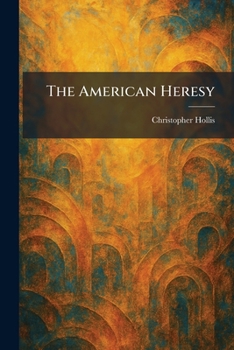
The American Heresy

"The American Heresy" is a provocative and insightful analysis of the development of the American political landscape from its founding through the early twentieth century. Christopher Hollis examines the trajectory of the United States, arguing that the nation underwent a fundamental shift-a "heresy"-that moved it away from the agrarian, decentralized vision championed by Thomas Jefferson toward a more centralized and industrial state.
Through a series of critical biographical and historical studies, Hollis explores the impact of key figures such as Alexander Hamilton, John C. Calhoun, Abraham Lincoln, and Woodrow Wilson. The work scrutinizes the persistent tensions between state sovereignty and federal power, the rise of industrial capitalism, and the subsequent transformation of the democratic process. Hollis provides a unique perspective on the American Civil War and its aftermath, viewing these events as pivotal moments that redefined the nation's character and its constitutional interpretation.
This work remains an essential read for those interested in the philosophical underpinnings of American government and the historical forces that shaped the modern United States. It offers a compelling look at how the country's original principles were challenged and ultimately altered by the pressures of history and shifting political ideologies.
This work has been selected by scholars as being culturally important, and is part of the knowledge base of civilization as we know it. This work was reproduced from the original artifact, and remains as true to the original work as possible. Therefore, you may see the original copyright references, library stamps (as most of these works have been housed in our most important libraries around the world), and other notations in the work.
This work is in the public domain in the United States of America, and possibly other nations. Within the United States, you may freely copy and distribute this work, as no entity (individual or corporate) has a copyright on the body of the work.
As a reproduction of a historical artifact, this work may contain missing or blurred pages, poor pictures, errant marks, etc. Scholars believe, and we concur, that this work is important enough to be preserved, reproduced, and made generally available to the public. We appreciate your support of the preservation process, and thank you for being an important part of keeping this knowledge alive and relevant.
Customer Reviews
ThriftBooks ® and the ThriftBooks ® logo are registered trademarks of Thrift Books Global, LLC
