


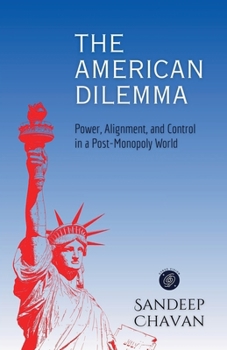
The American Dilemma

For decades, American power operated through alignment rather than enforcement. Its influence was quiet, structural, and largely uncontested. Pressure was rarely required because participation itself was beneficial.
That world no longer exists.
The American Dilemma by Independent Researcher, Educator and Author Sandeep J Chavan is not a book about decline, nor is it an indictment of the United States. It is a structural examination of what happens when a power shaped by monopoly conditions continues to operate inside a diffused, multipolar system.
Rather than focusing on events, personalities, or moral judgments, the book analyzes power as architecture-how incentives, dependencies, institutions, and identities interact under pressure. It explains why sanctions no longer converge behavior, why escalation produces adaptation rather than compliance, and why small conflicts now appear everywhere without resolving the larger tension.
At the heart of the dilemma lies a fundamental trade-off: rank preservation versus relevance preservation. Both cannot be maximized simultaneously. Holding yesterday's shape of power increasingly consumes more energy than it produces influence.
Drawing on the author's Unified Power Architecture (UPA) framework, the book explores:
Why pressure fails to restore alignment in modern systemsHow diffusion of capability reshapes global behaviorWhy fatigue replaces collapse as the dominant failure modeHow identity lag distorts leadership responseWhy silence, selectivity, and design now outperform enforcementThis is not a policy manual. It offers no predictions, prescriptions, or ideological conclusions. Instead, it provides a lens-one that helps readers distinguish loss of control from loss of power, reaction from architecture, and decline from necessary redesign.
Written with deliberate neutrality and long-horizon clarity, The American Dilemma is intended for readers who want to understand global power without propaganda, emotion, or tactical noise.
It is a book about what survives when dominance ends-and how power must be redesigned to endure.
Customer Reviews
ThriftBooks ® and the ThriftBooks ® logo are registered trademarks of Thrift Books Global, LLC
