


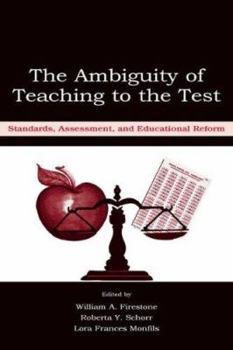
The Ambiguity of Teaching to the Test: Standards, Assessment, and Educational Reform
No Customer Reviews

Select Format
Select Condition 
Book Overview
Testing is one of the most controversial of all state and federal educational policies. The effects of testing are quite ambiguous. The same test may lead to different consequences in different circumstances, and teachers may use very different strategies to prepare students for tests. Although most experts agree that mandatory testing leads to teaching to the test, they disagree about whether it leads to meaningless drill, wasted time, de-professionalizing teachers, and demotivating students, or to more challenging and thoughtful curricula, more engaging teaching, increased student motivation, and increased accountability.
To help sort through this ambiguity and provide a firmer basis for decisions, The Ambiguity of Teaching to the Test: Standards, Assessment, and Educational Reform offers a hard look at the effects of state testing, and thoroughly examines the ambiguity of test preparation and how test preparation practices are influenced by what teachers know and the leadership coming from the school and district. Drawing on data from a three-year study of New Jersey's testing policy in elementary mathematics and science, it helps to explain the variety of ways that teachers modify their teaching in response to state tests, raises important questions, and offers useful guidance on how state policymakers and local and district school administrators can implement policies that will improve educational equity and performance for all students. It also offers an in-depth analysis of classroom practices that should inform teachers and teacher educators whose goal is to meaningfully implement conceptually based teaching practices. This comprehensive look at the statewide variation in testing practice features:*a data-based, non-ideological treatment of how testing affects teachers, in a field characterized by ideologically driven beliefs and by anecdotes;
*an extensive and well-integrated combination of qualitative and quantitative data sources that provide a statewide overview, as well as an in-depth analysis of teachers and classrooms;
*a careful analysis of the variety of forms of teaching to the test; and
*a multilevel exploration of how a variety of personal and leadership factors can influence teaching to the test. This is an important book for researchers, professionals, and students in educational testing, educational policy, educational administration, mathematics and science education, educational reform, and the politics and sociology of education. It will also prove useful for state policymakers, school and district leaders, and teacher educators and curriculum specialists who are making decisions about how to design and respond to new testing systems.
Format:Paperback
Language:English
ISBN:0805845690
ISBN13:9780805845693
Release Date:May 2004
Publisher:Routledge
Length:112 Pages
Weight:0.79 lbs.
Dimensions:0.6" x 6.3" x 9.0"
Customer Reviews
0 rating
Copyright © 2026 Thriftbooks.com Terms of Use
| Privacy Policy | Do Not
Sell/Share My Personal Information | Cookie Policy | Cookie Preferences | Accessibility Statement
ThriftBooks® and the ThriftBooks® logo are registered trademarks of Thrift Books Global, LLC
ThriftBooks® and the ThriftBooks® logo are registered trademarks of Thrift Books Global, LLC
