


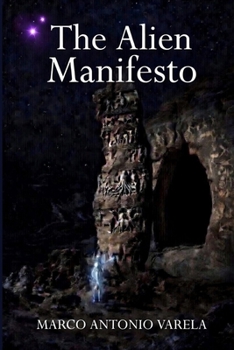
The Alien Manifesto

Here it is - written to make a reader buy it, under 4000 characters:
THE ALIEN MANIFESTO
For two hundred and eighty-seven thousand years, something has been watching.
It watched when it modified the human genome at the precise moment the fossil record shows an inexplicable leap in cognitive capacity - the sudden, simultaneous emergence of symbolic thought across three continents, overnight, everywhere at once, as though someone flipped a switch. It watched when it supervised the impossible geometry at G bekli Tepe, teaching hunter-gatherers with no writing and no wheel to hold an architectural plan in their minds across forty years of construction. It left its calling card in the Nevada desert in 1947, two years after Trinity, and has been monitoring every nuclear weapons system on Earth ever since - disabling ten missiles at Malmstrom Air Force Base in 1967, holding a Soviet launch sequence for fifteen seconds in 1982, always stopping seven seconds short of the irreversible.
It has been here since the pharaohs stacked limestone. Disguised as a rock. Waiting to see what we would do with ourselves.
When consulting detective Sherrinford Quill is called to a locked room in Cambridge - impossible frost on the sealed window, ash of non-terrestrial composition on the carpet, an Antarctic ice core excised with molecular precision - he finds the thread that leads to all of it. In forty-seven minutes, he begins to pull.
But The Alien Manifesto is not told by the detective. It is told by the watcher.
Zenthari of the Veil is the last active observer of the Seraphim Concordance, an ancient institution that has been running the Earth program since before humanity could write. For twelve hundred years he has been on station above this planet, disguised as asteroid 433 Eros, filing the clinical reports his institution requires and the private notations it does not read - the honest record of what it is like to watch a species develop for three centuries of your own life and three hundred millennia of your program's history. He has maintained perfect professional distance. He has never communicated with the subject population. He has never intervened.
And then Sherrinford Quill walks into a locked room and reads it in forty-seven minutes, and everything Zenthari thought he understood about his own relationship to what he has been watching begins, quietly and irrevocably, to change.
Set against the full sweep of human history - the genetic modification that made us who we are, the first gardens of G bekli Tepe, the Bronze Age collapse, the nuclear age, the present moment - The Alien Manifesto is a novel about distance and presence, patience and recognition, and the specific cost of watching something for three hundred thousand years and finally, in seven days, being seen.
Told in two interlocking voices - Zenthari's official Concordance logs and his private notations, filed across twelve chapters that move from the deep past to the seventh day - the novel asks a question that no first-contact story has asked before: what happens to the watcher when the watched finally looks back?
The last word belongs to the gardener.
Comparable to Kazuo Ishiguro's Klara and the Sun and Ted Chiang's Story of Your Life, with the procedural precision of a John le Carr thriller and the cosmic scope of Arrival
Customer Reviews
ThriftBooks ® and the ThriftBooks ® logo are registered trademarks of Thrift Books Global, LLC
