
Skip to content
Scan a barcode
Scan
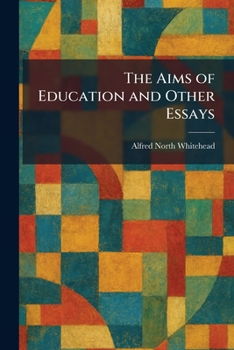
Paperback The Aims of Education and Other Essays Book

ISBN: 1025265203

ISBN13: 9781025265209

The Aims of Education and Other Essays

Select Format

Select Condition ThriftBooks Help Icon

Recommended

Format: Paperback

Condition: New

$20.96
Ships within 2-3 days
Save to List

Book Overview

"The Aims of Education and Other Essays" is a seminal collection of lectures and essays by the renowned philosopher and mathematician Alfred North Whitehead. In this influential work, Whitehead challenges traditional educational methods, advocating for a shift away from "inert ideas"-information that is received into the mind without being utilized, tested, or thrown into fresh combinations. He argues that the primary goal of education is not simply the accumulation of facts, but the acquisition of the art of the utilization of knowledge.

Whitehead explores the rhythmic nature of intellectual growth, dividing the learning process into the stages of romance, precision, and generalization. Beyond general pedagogy, the collection delves into the intersections of science, mathematics, and technical training, emphasizing the importance of a holistic approach to learning that integrates specialized skill with a broad philosophical understanding. Written with intellectual depth and clarity, "The Aims of Education and Other Essays" remains a cornerstone of educational philosophy. It provides a profound critique of academic specialization and a compelling vision for how schools and universities can foster vibrant, creative minds capable of applying knowledge to the complexities of the modern world.

This work has been selected by scholars as being culturally important, and is part of the knowledge base of civilization as we know it. This work was reproduced from the original artifact, and remains as true to the original work as possible. Therefore, you may see the original copyright references, library stamps (as most of these works have been housed in our most important libraries around the world), and other notations in the work.

This work is in the public domain in the United States of America, and possibly other nations. Within the United States, you may freely copy and distribute this work, as no entity (individual or corporate) has a copyright on the body of the work.

As a reproduction of a historical artifact, this work may contain missing or blurred pages, poor pictures, errant marks, etc. Scholars believe, and we concur, that this work is important enough to be preserved, reproduced, and made generally available to the public. We appreciate your support of the preservation process, and thank you for being an important part of keeping this knowledge alive and relevant.

Customer Reviews

5 ratings

A Book for Students, Parents and Teachers

This book is as fresh and usefull as it was 50 years ago when I first read it. The summary of this book, that is Whitehead's concept of the message to be received from the writing, is the first line of the book. Dr. Whitehead assures us the purpose of education is to enrich life and "scraps of information have nothing to do with it." This magnificent book belongs on the shelf of every person who is interested in education of mankind throughout life. We are fortunate to have been blessed by this scholar and humanist.

Powerful insights into the nature of learning

Whitehead's essays are timeless. For the reader who instinctively feels that learning must be meaningful to be of value, Whitehead is a must read. This book is well suited to curriculum designers and/or instructors who feel strongly about including experiential activities. Whitehead's insights would be especially useful for decision-makers/sponsors of learning who must demonstrate a positive return on their investment. The first-time reader will have to overcome a sense of frustration that Whitehead's keen observations are as applicable today as when they were written nearly seventy years ago.

Provocative

The highlight of this book is chapter 9 as he discusses ontology, i.e., the nature of what truly exists. He talks about the present as always changing into the past and the future. In other words, the present isn't really present. To illustrate how change occurs he mentions a piece of meat as it is cooking. If left unattended, when will the meat cease to be meat? In places he gets bogged down in jargon and complexity. He starts by discussing education in general, noting that in addition to English, a student should study French and Latin, that certain things can only be known though the original tongue of the author. Overall this is an insightful collection of essays.

Changed my life at age 17 -- Thank you, thank you!

The university that accepted me into its six-year medicine program required that I read this (and other) book(s) during the summer before entering their program. It changed my life! It helped me to think about what I wanted to get out of formal education, how I wanted to develop my own mind through the rest of my life, and how to choose education that serves my objectives. This book made me a more knowledegeable consumer and user of education.

Extremely Timely Teaching

Although most of these essay were written over eight decades ago, I found them to be extremely timely, especially the title essay. Whitehead shoots straight. He begins by stating that most teachers transmit "inert" ideas in their practice--they teach material that has to practicable bearing on providing any meaningful help to students. He identifies three different stages or rhythms in educational methodology that happen in tandem and in rotation (I visualize a geocentric universe filled with epicycles of rotating moons and planets to illustrate the layers and rings of motion in teaching). He bases these stages on Hegel's Thesis, Antithesis and Synthesis, but he adapts them to the classroom and human learning. He calls these rhythms Romance, Precision, and Generalization. In Romance, the teacher needs to awake the sense of wonder and curiosity in a student's mind. This will provide the impetus to pursue the learning to the next stage: Precision. In the second stage, the student studies by drill and repetition the formulae, rules, and grammars that build upon a thorough knowledge of a filed. In the third stage, Whitehead declares that the student needs to move into a realm of Generaliztion. In this rhythm, the student makes connections, applications, and full, mature usage of the material and ideas.I wish more teachers and teachers interested in developing their pedagogical methodolgy would take the time to read this short masterful book.
Copyright © 2026 Thriftbooks.com Terms of Use | Privacy Policy | Do Not Sell/Share My Personal Information | Cookie Policy | Cookie Preferences | Accessibility Statement
ThriftBooks® and the ThriftBooks® logo are registered trademarks of Thrift Books Global, LLC

GoDaddy Verified and Secured